

Foreword
Fourteen years have passed since this document was originally published by the Center for Immigration Studies in July 2011, halfway through the first term of the Obama presidency. We went from the Obama years to the first Trump administration, to the Biden administration, and have now arrived at Trump 2.0. The political landscape has swung pendulum-like to the right, then left, then right again. Nowhere is that more evident than with the phenomenon of illegal immigration to our country or, to be more specific, how the federal government has chosen to deal with it.
Immigration has been used as a tool for social engineering by the left for many years — often with the acquiescence of leaders on the right (remember the infamous bipartisan “Gang of Eight” amnesty bill?), at least up until the first Trump election, when he proved that enforcement of the immigration laws was a winning political formula.1 Unfortunately, one term was not enough to permanently change the course of events that had been years in the making. Then came Biden.
The Biden administration's open-border years were presided over by a disingenuous Department of Homeland Security (DHS) secretary who perpetually declaimed that illegal immigration was under control, notwithstanding overwhelming evidence to the contrary. The president and his DHS secretary deliberately inflicted a disaster from which the country may or may not recover, given that 12 to 14 million aliens entered the U.S. without inspection or under dubiously applied provisions of law such as immigration parole.
We will have to wait and see what the second Trump term is able to accomplish in rolling back the tide of immigration lawlessness, although in a few short months previously hamstrung federal agents have taken back into custody and removed a significant number of the Biden-era entrants under the watchful eyes of the president's eminently capable Border Czar, Tom Homan, and DHS Secretary Kristi Noem.
Many more have opted to leave rather than face possible arrest, detention, and removal. Analysis from CIS's own Director of Research Steven Camarota and his associate Karen Zeigler establishes that the population of illegal aliens in the U.S. has declined by 1.6 million since the beginning of the year; much of that almost certainly attributable to the change of administrations and their radically divergent immigration policies.2
What is interesting, though — with a few notable exceptions discussed below — is that the immigration laws when I originally wrote this document in 2011 are almost exactly the same as existed through the Biden years all the way up to the present.
How could this be?
There are at least three explanations: First, as I mentioned earlier, President Joe Biden and his cabinet, specifically DHS Secretary Alejandro Mayorkas, willfully failed to heed the demand of Article II, Section 3 of the Constitution to “take Care that the Laws be faithfully executed”, and they paid no real political price for it.
Second, the Biden administration willfully misinterpreted (“twisted” or “mangled”, or even “weaponized” might be more apt) the statutory provisions of the Immigration and Nationality Act (INA). Doing so allowed them to achieve record influxes of patently inadmissible aliens under thinly veiled covers of law, such as applying the immigration parole provision to hundreds of thousands of aliens, despite the clear statutory language that it be applied “only on a case-by-case basis for urgent humanitarian reasons or significant public benefit”.
Third is the federal courts. One of the reasons that open-borders advocates often achieve success is because of the notion of “standing” used by the federal court system. In order to sue one must have standing, that is to say the plaintiff has to have suffered (or will likely suffer) a concrete injury, the injury is "fairly traceable to the challenged conduct", and the court can redress the alleged injury if it grants the plaintiff's requested relief.
When advocates sue on behalf of an alien who has been denied a benefit or ordered removed or suffered some other adverse action (often cherry-picking cases to fall within the boundaries of a judicial district more likely to give a favorable outcome), standing is unlikely to be questioned. It only takes one alien plaintiff in any of the 94 district courts to achieve a victory if the judge is amenable to issuing a restraining order that halts government action on other similarly situated aliens (which may be as loosely construed as sharing a nationality or ethnicity).
By contrast, there is no one to speak for the public generally when government administrations, such as that presided over by Joe Biden, play fast and loose with the laws in favor of allowing unrestrained influxes of aliens who arrive without visas or vetting (and without vaccinations during the height of the Covid pandemic when most of the rest of the country was under one form or another of lockdown), to flood across our borders. This is because the public is not construed to have anything more than a “generalized harm”, which fails for standing purposes even though such egregious lapses in “taking care that the laws be faithfully executed” jeopardize the futures of our children, their children, and their children's children.
Increasingly in past years, some states have worked to overcome the hurdle of standing by filing suit individually or in groups, on behalf of themselves and their citizenry, to halt at least some of the worst abuses. Success in these efforts varied, and was limited at best — that is, until enactment of the Laken Riley Act in January of this year. That act, discussed further in the report, now provides states the statutory grounds for standing in five key areas.
This, then, is the political and operational landscape that now prevails.
Introduction
Many people, including, surprisingly, those whose occupations might bring them into contact with federal officers who enforce immigration laws,3 don’t seem to have a clear notion of how removal proceedings4 against an alien take place, and exactly what “due process” means in that context.
For instance, state and local police and prosecutors often do not charge or will move to dismiss charges against an alien, once Immigration and Customs Enforcement (ICE) officers or agents express interest in removal, in the mistaken belief that once ICE takes custody of the individual, he (or she) will be forthwith whisked to a bus, plane, or train, and unceremoniously shoved across the border or dropped into the midst of his or her country of origin. Such notions are greatly mistaken.
This report describes the enforcement actions that take place prior to, and that result in initiation of, removal proceedings, one form of which is a hearing before an immigration judge.5
It describes a frequently cumbersome and dysfunctional deportation and exclusion process, but at the same time discusses new and innovative ways of enforcing old laws that are being accomplished without the need for legislative action, for instance through executive orders, as well as quite simply applying long-existing statutes according to their plain meaning — for instance, holding aliens in detention when this is what the law requires.
Key observations:
- Historically a large percentage of aliens have fled from removal proceedings — perhaps as many as 59 percent of all those released to await hearings. While from the alien’s perspective, this makes sense if you know there is no relief from removal available to you, it renders the entire system dysfunctional by leaving a subclass of alien fugitives free to roam the streets while achieving very few actual removals. The administration has addressed this by eliminating bonds for whole classes of aliens to which they were never really entitled as a matter of law.
- The exercise of “prosecutorial discretion” (choosing to forego initiation of proceedings against many illegal aliens) that was mandated in the Obama years turned the notion of discretion on its head by making it the rule rather than the exception.6 Worse, this notion of a deliberate election of nonenforcement planted the kernel for the lawlessness that would follow in the Biden years.
- The Immigration and Nationality Act (INA) provides for several types of due process for aliens, depending on their circumstances of arrival and stay. The law does not require that all removals be ordered by an immigration judge. The Trump administration is focused on using all available non-judicial means of due process to fast-track removals and reduce use of available bed space while at the same time not adding to the logjam of cases confronting the immigration courts.
- The option of voluntary return, where the alien requests to be returned home in lieu of removal proceedings, is not really “voluntary”, but is beneficial to the alien because it carries fewer consequences if the alien returns illegally. Although potentially subject to misuse if granted to aliens with significant criminal histories, it has become a go-to tool of the current administration as it seeks to increase the pace of removals in order to undo the damage done during the Biden years.
- The total number of apprehensions of illegal aliens by ICE officers is increasing exponentially under the second Trump administration. In addition, with a largely quiescent border, Customs and Border Protection's U.S. Border Patrol (CBP/USBP) agents are being deployed to aid ICE in interior apprehensions, especially in sanctuary hotspots such as Los Angeles.
- Under Trump 2.0, DHS and its subordinate agencies are using technology to encourage illegal aliens to self-deport in return for a promise not to arrest and detain them while they await departure arrangements at government expense, following by grant of a $1,000 stipend on verified return to their home countries.
Background
The Supreme Court has said that, where expulsion proceedings are concerned, due process for aliens in the United States is whatever Congress chooses it to be — subject to certain constraints imposed by the Constitution, and as ultimately interpreted by the courts themselves, that is.
Over time, by means of law, regulation, and binding precedent decisions, a kind of hierarchy of due process rights has evolved for aliens who are placed into removal proceedings:
- Aliens who have entered and remain in the United States illegally are, understandably, accorded the least amount of due process.
- Nonimmigrant aliens, who may have originally entered legally, but later overstayed or otherwise violated the conditions of their admission, have somewhat more due process rights.
- Lawful resident aliens who are alleged to have committed some act rendering them removable (by commission of a crime, for example) are entitled to the most due process under the law based on their status and “equities” in the United States. The term “equities” usually refers to close family members, especially U.S.-born children, but also refers to ties to the community, stable employment, and length of residence in the United States for purposes of seeking a cancellation of removal.
However, this hierarchy is not hard and fast, and a major factor that enters into how, and what kind of, removal proceedings are commenced revolves around the legal charges filed against the alien immediately after apprehension: Certain removal charges carry with them the requirement, or at least the opportunity on the part of the government, to initiate certain kinds of proceedings that take place outside the parameters of the immigration court. What’s more, it is at the discretion of the government to decide whether to lodge formal charges against an alien, to decide what charges to lodge, and such decisions are inevitably influenced by cost and economy. For example, the government may choose to permit an alien without a criminal history, or even who is a petty criminal, to request “voluntary departure” in lieu of holding him in detention for an extended period of time while a removal hearing is conducted by an immigration judge.
Although removal proceedings are administrative (civil) in nature, over the course of time they have taken on many of the trappings of a criminal proceeding — at least those removal proceedings that are conducted by immigration judges have — albeit with differing standards for introduction of evidence and adjudication of removability (for instance, the “beyond a reasonable doubt” standard doesn’t apply). Such trappings include, among other things:
- Issuance of warrants of arrest;
- Provision of an advice of rights to aliens taken into custody;
- Setting of a bond or other form of pre-hearing conditional release; and
- The right to counsel (at no expense to the government).
As mentioned, many removal proceedings take place in front of an immigration judge, who is responsible for conducting an impartial hearing, listening to testimony, accepting evidence, reviewing and ruling on legal motions and briefs from both sides, and arriving ultimately at a decision as to whether the alien should be removed from the United States. Just as with other “judicial” proceedings,7 such hearings can take a substantial amount of time (and money), may involve a number of continuances and adjournments, and, if the alien flees, result in an unenforceable order of removal until such time as he can be found and taken back into custody.
Function and Dysfunction
Aliens who flee from proceedings are traditionally called “absconders” or, more recently, “alien fugitives”. The number of such individuals is high — perhaps as many as 5 percent of the total number of aliens illegally in the United States, according to past estimates.8 Various sources put the number of aliens illegally in the United States between 12 to 14 million, meaning that there may be up to 600,000-700,000 alien fugitives at large, a significant number of whom are removable based on criminal convictions. Note that this percentage calculation is based on the number of fugitives compared with all aliens in the United States — not just those who were put into proceedings and fled. If couched solely in the context of the percentage of aliens who are put into proceedings and abscond, the percentage would be more relevant — and much, much higher — perhaps as high as 59 percent of all aliens arrested and then conditionally released to await their hearings.9 That may be why past administrations have chosen not to put it into that context; it becomes a stark reminder of the failure of the present system, and the softer number of 5 percent masks the level of dysfunction.
Considered logically, the large volume of alien fugitives should not be a surprise. If an alien absconds and is later captured, what is the worst he can expect? To be removed — the same thing that will happen if he sticks around. So on a cost-basis analysis from the alien’s perspective, absconding makes sense: If you are in proceedings, and have few equities and no reasonable basis to believe you will be permitted to stay, why not choose to treat the bond money you’ve posted as a fine and accept its loss — the cost of having been caught — and flee, hoping to stay under the radar for as long as possible. Who knows? With luck, maybe you can even remain undetected until there is a new amnesty program or, failing that, at least living and working in the United States, albeit often enough with under-the-table wages and no worker protections, or by using fraudulent, stolen, or counterfeit documents.
One probable reason for the high absconder rate, though it remains publicly unacknowledged, is the length of time it takes for a removal proceeding to begin for aliens falling into the “non-detained docket”. Many aliens, following the seasonal flow of jobs, or out of indifference, or with well-thought-out intent, choose to get on with their lives and disappear.
The large number of absconders begs the question: Why has the government perpetually accepted this state of affairs, being as it is de facto evidence of a system’s fundamental inadequacies? Why not, for instance, keep more aliens in detention? Until this administration, the answers to these questions ran the gamut from legal, procedural, and fiscal realities (including lack of available bedspace) on one hand, to philosophy and politics on the other hand.
On July 25, 2025, that changed with issuance of a policy memorandum requiring mandatory detention10 without bond for all alien applicants for admission (which includes illegal border-crossers who did not present themselves for inspection). Statutorily, this had always been the law; past administrations simply opted not to even attempt it. Significantly, in two recent cases, the Board of Immigration Appeals (the appellate division of the immigration courts) took on the issue and confirmed the right of the government to detain these individuals until such time as their proceedings are completed.11
Over the years, the perpetual logjam of cases within the immigration courts gained scrutiny by various organizations and legal groups that favored looser rules, including the American Bar Association (ABA) and the Migration Policy Institute (MPI).12 Perhaps unsurprisingly, given their philosophical focus as migrant and defense advocacy groups, neither the ABA nor MPI ever advocated expanded use of streamlined or non-judicial forms of due process in removal cases. Instead, they suggested a substantial increase in the number of judges and support staff; additional opportunities for the use of alien defense lawyers (“attorneys for the respondent” in the parlance of immigration removal proceedings); more, and increased grants of, types of relief from removal; expansion of the appellate rights of aliens in removal proceedings; and additional use of prosecutorial discretion in deciding whom to arrest vs. whom to ignore among the illegal alien population of the United States. Needless to say, none of these solutions would have significantly improved federal immigration enforcement efforts; rather, they would have simply helped make the problem disappear from public view.
Nothwithstanding the shortcomings, in March 2011, then-ICE Director John Morton issued a policy memorandum — virtually at the same time that MPI issued its report and within weeks after the ABA issued its report — dictating the use of prosecutorial discretion by field officers in their daily enforcement activities, citing, among other documents, a memorandum from prior Immigration and Naturalization Service (INS) Commissioner Doris Meissner (who was by then a senior fellow with MPI and co-author of its report).13
The difficulties in use of prosecutorial discretion by field officers were/are multiple. First, there is the risk of releasing an individual without charge who later commits a heinous act. Field officers understood that they had no assurance that they wouldn't be second-guessed, even though the internal pressures all pointed them in that direction. Second, when prosecutorial discretion becomes the rule rather than the exception for whole classes of illegal aliens, is it truly “discretionary”? Third, walking away from the aliens themselves provided them no status, no fallbacks, nothing. They were simply being left to their own devices by a feckless and irresponsible policy.
ICE's exercise of prosecutorial discretion also took a second tack: dealing with burgeoning court backlogs by jettisoning pending cases. In media reports at that time from various cities throughout the country, government trial attorneys were reported as filing hundreds of motions before immigration judges for case dismissals, based on loose criteria such as the alien having “no serious criminal history”.14 It was a disingenuous solution to the backlogs problem, given the thousands of productive hours that had already been invested by officers and agents in apprehending and processing the aliens whose cases were dismissed, and evinced an obvious binge-and-purge mindset rather than a serious effort at solutions.
What began as prosecutorial discretion during the Obama administration, flawed as it was, became the precursor to even more restrictive enforcement policies during the Biden administration, when Alejandro Mayorkas, Obama's former director of U.S. Citizenship and Immigration Services became Biden's DHS secretary. It seems clear that Mayorkas absorbed those lessons and, with a boss either in agreement or too detached to care, doubled down on enforcement restrictions, and then doubled down again.15
Fortunately, on the very day of taking the oath of office, President Trump rescinded the failed and deceptive policies of the past and issued a series of executive orders reinstituting the rule of law, and within a month the thousands-per-month illegal entries across the border had trickled down to near zero. Of course, this still leaves the millions who did effect entry to be tracked down, put into proceedings in the most expeditious way permitted by law, and then removed.
Deportation Types and Processes
Arrest
Aliens who are subject to removal come to the attention of federal officers in a variety of ways. Border Patrol agents encounter them attempting illegal entry, primarily on the northern and southern land borders. Customs and Border Protection inspectors encounter them seeking entry at land, air, and sea ports of entry — sometimes with false papers, more often by means of a concocted story that masks their intent to enter and remain in order to work illegally.
ICE officers and agents who are responsible for immigration enforcement in the interior of the United States actively seek out illegal aliens as the consequence of leads, as the result of fugitive investigations, or in the conduct of cases against employers alleged to knowingly hire illegal workers,16 and, often, in their liaison with police and correctional authorities through the Criminal Alien and Institutional Removal programs, which are designed to identify aliens who have been arrested and/or incarcerated for crimes committed in the United States. In these cases, ICE places a detainer (a “hold” in everyday parlance) against the subject. If and when he is ready for release by the state/local criminal justice authorities, they notify ICE, which then has 48 business hours to honor its detainer by taking physical custody of the alien.
Regrettably, there are hundreds of “sanctuary” states, counties, and municipalities that ignore ICE detainers17 and routinely release dangerous criminal aliens back to the streets, with a concomitant risk to the public, including most particularly immigrant communities, which are often enough the victims of crimes committed by alien criminals and recidivists.
The Biden administration took a hands-off approach to the problem of sanctuaries, in line with its not-so-benign indifference to all forms of immigration enforcement.
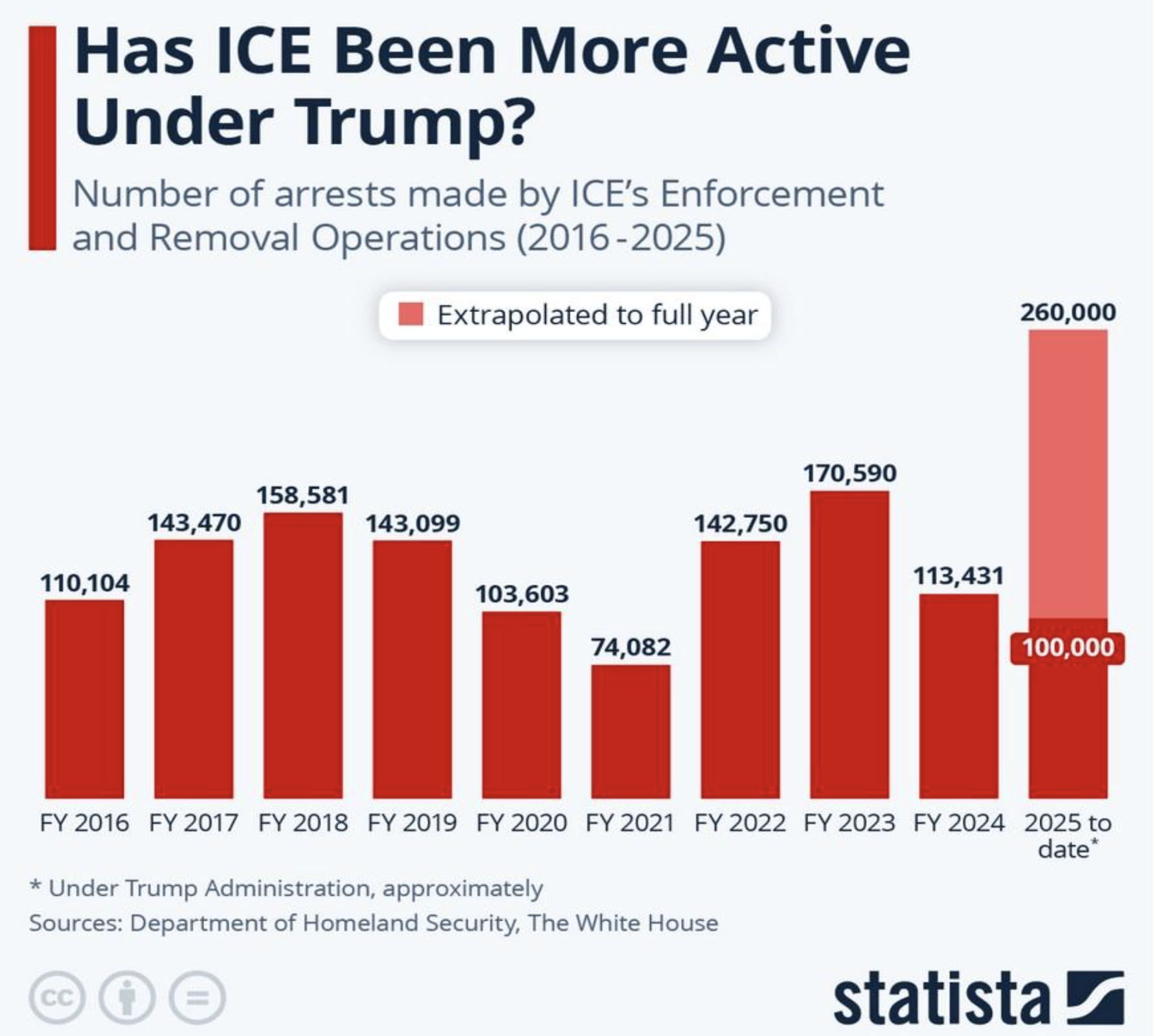
By contrast, in less than the first half of the Trump administration's first year, ICE arrests are on a course to double yearly arrests, as evidenced by the following Statista figurebased on DHS and White House data.18 In addition, ICE and USBP are routinely conducting surge operations in sanctuary hotspots, such as Los Angeles, Boston, Chicago, and elsewhere to amplify the message that nowhere is off limits, and there are no safe zones from the reach of immigration law.
 |
Processing and Service of a Charging Document
Once an alien has been taken into custody by the Border Patrol, by CBP inspectors, by AMO, or by ICE, he must be “processed”; that is, the equivalent of an arrest report must be prepared; fingerprints, photographs, and a DNA swab taken; systems checks performed; and any prior file materials relating to this alien obtained in order to determine the nature and extent of his history in the United States, including prior removals, additional crimes for which he may have been charged/convicted, etc. It is not uncommon for “kickbacks” from fingerprint and/or photograph submissions to the two primary databases (IAFIS, belonging to the FBI, and IDENT, belonging to DHS) to reveal to the arresting DHS officers that the alien has been using an alias to conceal his past and his identity, which is unmasked once the database returns are received by the processing officers. (These returns are usually obtained within hours because they are submitted digitally.) Once the information is compiled, two decisions must be made: whether or not to release on bond or other conditions (now severely limited) and what specific removal charges to levy against the individual.
As mentioned previously, removal proceedings in the immigration court have many of the trappings of criminal judicial proceedings even though they are civil-administrative in nature. But there are also some key differences, which become evident to anyone able to observe the movement of an alien through the deportation life cycle from arrest to removal by DHS officers. For example, officers or agents in certain designated supervisory or managerial positions are authorized to act in the same way that prosecutors and magistrates are understood to act within the criminal justice system. It is those officers, not immigration judges, who:
- Decide what form of due process the removal will take (that is to say, a hearing before an immigration judge or one of the several other forms of due process that don't require a court hearing);
- Issue warrants of arrest (either pre- or post-apprehension, as will be discussed shortly);
- Determine which legal causes for removal will be lodged on the charging document;
- Decide the amount of bond or other conditions of release (subject to a redetermination hearing by an immigration judge if the alien appeals the bond or conditions as unreasonable); and
- Sign, as the issuing officer, the legal documents that will be served on the alien notifying him of the removal charges being levied against him (usually, but not always, in the form of a Notice to Appear (NTA), which is also provided to the immigration court as the foundation on which the immigration judge will conduct his hearing). Preparing the charging documents and other forms is more than a few mouse clicks or boxes to be checked off. Today, agents processing an alien for removal must fill out well over a dozen — often closer to two dozen — forms for even the simplest removal cases. Here is a representative sampling of the forms that may be required, depending on the case circumstances:
- Immigration Detainer
- Report of Removable Alien (equivalent to a police arrest report)
- Advice of Rights (which includes advice of the right to notify consular officials from the alien’s country of origin)
- Sworn Statement
- Notice to Appear/Bond/Custody Processing Sheet (used to obtain supervisory approval to move forward with a charging document and custody decision-making)
- Notice to Appear (or other formal charging document, such as Notice and Order of Expedited Removal or Notice of Reinstatement of Prior Removal Order for aliens who reenter the U.S. after having been previously deported)
- Warrant of Arrest
- Notice of Custody Determination
- Immigration Bond Form (for those who will be posting bond in lieu of detention)
- Order to Detain (or, alternately, Order of Release on Recognizance)
- Alien Booking Record
- Property Receipt Form
- Notice of Action (for voluntary return cases)
- Notice of Visa Cancellation
- Information for Travel Document or Passport (prepared for foreign consular officials for aliens who do not have the documents required by their countries of origin for repatriation)
One of the most important changes implemented by ICE under President Trump is an insistence on hewing to the letter of the law. For instance, just as policy now precludes release for aliens who crossed the border without inspection, so too officers and agents are being instructed to ensure that they are processed as “Expedited Removal” cases (explained below), instead of being added to the onerous backlog of cases pending before the immigration courts. Similarly, aliens who were previously removed are placed into “Reinstatement of Prior Order of Removal” proceedings.
Needless to say, under the Obama and Biden administrations, it was almost axiomatic that officers were expected to place an alien into immigration court hearings — if they were charged at all, and even if abbreviated non-judicial removal proceedings were appropriate — because this inevitably ensured that they would be released from detention, and at the same time it put them into a “non-detained” court docket stretching years into the future.
These important policy shifts minimize the amount of time spent in detention, which is critical to maintaining control over the docket of aliens under proceedings; and they fast track these cases for actual deportation rather than adding to the absurd number of alien absconders loose in the interior of the United States under unexecuted final orders of removal.
Conditions of Detention/Release
Presupposing that the alien is not one of the classes of deportable individuals whose detention is required by statute, the key factors in determining detention or release are (1) whether the alien constitutes a flight risk; and (2) whether he constitutes a risk to the community.
While this latter factor is given serious consideration for obvious public safety reasons, it is equally obvious from the high volume of absconders discussed earlier that in the past, the flight-risk factor didn't weigh so heavily in the minds of DHS officers. Why? Because of simple economics and the law of supply and demand at work.
There are only so many detention bed spaces available at any point in time, and the cost of maintaining an alien in detention on a daily basis over many weeks — sometimes many months — can be high, particularly where the bed space is rented from county sheriffs or contract corporations specializing in such matters. What’s more, the profile of the detainee needs to meet the type of detention space available. Thus, faced with tying up a detention bed at great cost to hold an alien who has no criminal history, but may very well flee for lack of any substantial ties or equities, government officers often opted for release on low bond or personal recognizance conditions that were inadequate to ensure the alien’s future appearance at proceedings.
Following are the series of due process mechanisms DHS officers are charged with choosing in making custody and release decisions about an alien:
Notice to Appear in Removal Proceedings (NTA). It is possible to issue the Notice to Appear charging document without an accompanying Warrant of Arrest (WA). Think of the NTA in such a circumstance as the functional equivalent of a ticket or a summons — it notifies the alien that he will be obliged to appear in immigration court at a particular date, time, and place to answer the charges contained in the NTA, but it does not require a bond or other conditions of release. The alien is served the document, and a copy is provided to the court for docketing purposes. He may even be served such a document by mail to his address of record in lieu of personal service. If, however, he fails to appear at the hearing, he will be deemed a fugitive and his case will be referred to ICE for follow-up investigation, to locate and arrest — what’s more, the judge may proceed to hear the case in absentia (once proper personal or mail service of the NTA is established by the government trial attorneys), and therefore order removal even in the absence of the alien’s physical presence at the hearing. The problem here, of course, is finding the alien once he has fled for the purpose of executing the order of removal — not an easy task in a country geographically and demographically as large as ours, with a community of +37 million other legal and illegal aliens into which he can disappear.
Given the strong possibility of flight, the reader may be astounded to know that some aliens are the happy beneficiaries of an NTA issued by mail, without strings attached. This is because, in addition to the DHS agencies mentioned previously, adjudicating officers with U.S. Citizenship and Immigration Services (USCIS) are authorized under certain conditions to issue NTAs. Such officers are not generally conceived of as enforcement officers, insofar as their job is to decide whether to grant or deny a variety of immigration benefits available under the law. Issuance of an NTA happens in conjunction with a decision to deny an alien the status being requested — for instance, a denied request for asylum. Because the denial deprives the alien of a legal footing, when the denial is mailed it is accompanied by an NTA directing the individual to appear for a removal hearing before an immigration judge. At that hearing, the alien may renew his request for asylum before the judge. If it is again denied by the judge and there is no other form of relief available to him, the alien will be ordered to depart the United States.
There are also a few other circumstances in which NTAs are issued unaccompanied by a WA. Examples might include pregnant women, primary caregivers (usually mothers with small children), aliens with significant health issues, or the like. While in past administrations there were larger numbers of aliens served NTAs without arrest, this is no longer true.
Warrant of Arrest (WA). From the discussion above, you have probably surmised that the Warrant of Arrest is the fundamental trigger for custody decisions. Issuance and service of a WA on an alien invokes his right to expect that conditions of confinement or release will be set that are appropriate to the circumstances of his case and the severity of the charges being lodged. Note the key phrase, “appropriate to the circumstances of his case”. In addition to illegal border-crossers, aliens convicted of certain crimes are also ineligible for release under various provisions of the INA — provisions that were routinely flouted in the past.
A WA may be issued by the proper officers in advance — for instance, in the case of absconders, where it will sit in the file awaiting execution, pending the ability to locate and apprehend the individual by ICE officers. But in many instances it is not issued until after the actual apprehension or assumption of custody takes place, for the obvious reason that the supervisory officers with authority to issue a WA had no reasonable means to know in advance that the individual would be found and arrested. This would be commonplace, for example, with illegal border-crossers apprehended by Border Patrol agents in proximity to the border.
A host of release/detention possibilities available under the law and regulations flow from issuance of a WA on an apprehended alien in conjunction with service of the charging document. (Note that I say “charging document” and not “NTA”. That is because, as you will recall from my earlier remarks, not all charging documents in removal proceedings are NTAs — more about that later.) Following is a quick summary of alternatives, from least to most onerous, from the alien’s point of view.
Own Recognizance (OR). Once having been served a WA and NTA, an alien may be released on his own recognizance. This means he is being trusted to appear at the removal hearing without the requirement of posting a bond. It implies, you will recall, that he has met the two-pronged test for release pending his hearing: that he is a minimal flight risk and that he doesn’t constitute a danger to the community. Such a mechanism might be used when charging a lawful permanent resident alien (LPRA) who has somehow fallen afoul of the immigration laws and is now believed to be removable as a result of his conduct — for example, after he has been convicted of a nonviolent misdemeanor offense that is not categorized as an “aggravated felony”.19 A release on OR can also be accompanied by other conditions, such as periodic contact with local ICE ERO officials as a way of assuring them that the alien has not taken flight. (There is also a program called “Alternatives to Detention”, described below.)
Bond. The law and regulations provide that an alien may post an appearance bond as a form of guarantee that he will appear when required — not only for the hearing, but also up to and including surrendering himself for physical removal if so ordered. Failure to comply with the conditions results in a breach of the bond, and the money posted with the government is forfeited. The regulations provide that an immigration bond may be set no lower than $1,500. The actual amount of bond established in an alien’s case may be higher, depending on how his risk of flight and/or danger to the community has been assessed by government officers. This, however, is counterbalanced by the need to preserve detention space for serious offenders, and to ensure that an alien with no criminal history is not intermingled in a population of aliens with serious criminal histories.
An alien, other than one whose detention is mandated by law, who believes the amount is unreasonable may have a bond redetermination hearing before an immigration judge, who has the authority to reassess the conditions of release and lower the amount. It is not uncommon for judges to exercise this authority, notwithstanding the alien fugitive problem that confronts all entities involved in the immigration enforcement and expulsion system. Note that aliens (other than LPRAs) convicted of aggravated felonies are subject to mandatory detention under the law and are ineligible for bonds.
Alternative to Detention (ATD). Release of an alien on ATD after service of the WA and NTA might be thought of as a rough equivalent to house arrest, combined with the means of determining his whereabouts — usually by way of an electronic ankle bracelet, GPS-trackable phone (provided by the government), or other device that is monitored 24 hours a day, 365 days a year. The FY 2024 budget provided for well over $672 million for the two programs encompassed within the ATD umbrella.20 The ATD program is expensive in that ICE uses contract services to obtain the devices and to conduct the requisite monitoring, but undertaking ATD in-house, without use of a contract, would unlikely be any less expensive given officer salaries, benefits, overtime, and other costs. Note that there is no established immigration court docket specifically for aliens in the ATD program: Their cases are placed in the “non-detained” docket and therefore are subject to the inordinate delays attendant to all non-detained cases before a hearing commences, as was described earlier. This, of course, ratchets up the cost of the ATD program substantially.
Some immigration advocates and private members of the immigration bar have argued that because ATD constitutes a form of confinement, it meets the definition of “mandatory detention”, and therefore aliens convicted of aggravated felonies should be entitled to consideration for inclusion in the program. Fortunately so far, this down-the-rabbit-hole argument has met with no success because substantial evidence of its ineffectual use can be found in a variety of appalling cases, such as that of Carlos Martinelly-Montano, a participant in the program who later went on to commit vehicular homicide by killing a nun while driving drunk in Prince William County, Va., in August 2010. The handling of Martinelly-Montano’s case is Exhibit 1 in any reasoning person’s assessment of what is wrong with the federal government’s present immigration enforcement-and-removal regimen. He had been arrested and charged more than once for driving under the influence, but faced almost no legal consequences from either the local criminal justice system or the federal immigration authorities, despite his status as an illegal alien and a man who routinely and cavalierly flouted the drunk driving laws.21
Under the present administration, the future of ATD is in doubt. Officers have been directed to review ATD cases with an eye toward determining whether the initial assignment to the program was even appropriate, and if doubt exists, to make all reasonable efforts to reassume custody of that individual. Instead, DHS and ICE leadership are committed to expanding detention, transportation, and removal capacities throughout the country in order to meet the needs of robust, ongoing, interior enforcement operations.
Detention. No matter which DHS agency has initially arrested or taken custody of an alien, once a decision to detain has been reached — or if the alien does not or cannot post the bond that has been established — a transfer of custody to ICE occurs. This is because ICE, specifically the Office of Enforcement Removal Operations (ERO), acts as the immigration jailer for the federal government.
Actually, ERO conducts nearly all of the immigration functions of ICE, which has increasingly stove-piped its enforcement operations between ERO and its counterpart, Homeland Security Investigations (HSI), which since its inception has made immigration enforcement a lesser priority, with some of its leaders even suggesting that such work is unimportant or demeaning. This goes back to the founding of ICE, which was a shotgun marriage of the enforcement and investigative components of the two legacy agencies — Customs and INS. In many ways, HSI and ERO live with one another only titularly under the same roof. The consequence is that only a part of the agency’s total resources can truly be said to be engaged in immigration enforcement in the interior of the United States — exactly how many officers or agents and support staff isn’t precisely known, as ICE deems such information to be law enforcement sensitive.
In past years, alien detention became a hotspot in immigration enforcement as open-borders advocates and pro-migrant organizations recognized the outsized influence and pressure they could exert on left-leaning administrations. The result was that ICE undertook a significant review and restructuring of its detention policy, procedures, and facilities for nearly two years, leading to a soft approach to alien confinement. Consequently, many county and city jails were deemed too harsh or inadequate for use as alien detention centers (even though they met American Correctional Association standards and, ironically, were deemed perfectly adequate for incarceration of U.S. citizens). Contracts were canceled for inability to meet the new ICE National Detention Standards. The change was ill-timed given the agency’s publicly avowed intent to focus enforcement efforts on removing serious alien criminal offenders — who, logic would seem to dictate, should be housed in hardened, highly secure lockdown facilities.
Equally damaging, many state officials, sheriffs, and wardens throughout the country were left with a bad taste in their mouths by the imposition of unreasonable and unrealistic standards — a feeling that persists to this day. This is regrettable because it causes resistance that must be overcome by the Trump administration, which has recognized that it sorely needs help from those among the 50 states (and their political subdivisions) who are willing to collaborate in ensuring effective immigration enforcement: especially states immediately proximate to the border or with large immigration populations whose communities are most directly and adversely impacted by crime committed by aliens, and stress on their respective health and social service systems.
Up until passage of the One Big Beautiful Bill (OB3) Act on July 1, 2025, ICE maintained a relatively constant funded capacity of between 34,000-36,000 detention beds nationwide.22 That space consists of a mix of government-owned facilities, facilities owned and run by private corporations via government contract, and space obtained from police and sheriff’s department jails via intergovernmental services agreements (IGSAs). The daily cost varied radically, depending on the locale and the contracted arrangements. Even though required by Congress to maintain those beds at full capacity, the agency often came up with reasons for why it was unable to do so, although never acknowledging that those reasons had to do with policy and proclivity rather than legitimate obstacles.23
OB3 appropriated substantial new monies for all areas of immigration enforcement, including detention. A massive new facility is being constructed inside of the Ft. Bliss military base and other sites are being located or expanded throughout the country.
More interestingly, and contrary to the go-it-alone attitude of past administrations, the Trump administration is actively courting state participation, including through operation of joint facilities such as the Dade-Collier Transition and Training Airport facility (“Alligator Alcatraz”) and the Baker Correctional Facility (“Deportation Depot”) in Florida, as well as a wing of Louisiana's Angola State Penitentiary currently being revamped. Other facilities are also coming online in Indiana and Nebraska. These joint facilities are not only beneficial because of the added bedspace they offer, but because they foster a spirit of cooperation between federal and state authorities in the realm of immigration enforcement. This will go far toward helping to heal past rifts.
But even with an abundance of new facilities, whether federally owned or contracted, or owned and operated jointly by states and the federal government, it remains a truism that the more quickly aliens occupying detention space can be processed in, moved through their proceedings, and removed, the more effective the federal government will be in its obligation to police unlawful immigration to the United States. This self-evidently is a prime rationale for making maximum use of statutory authorities to fast-track removals whenever possible.
Types of Removal
The INA provides for several types of due process to be accorded to an alien, depending on the facts and circumstances surrounding his entry into, and stay in, the United States — e.g. whether the initial entry was legal or not, whether he has been convicted of a crime, the type of crime committed, etc.
Voluntary Departure/Voluntary Return (VR). Voluntary Return may be granted by federal officers in lieu of presenting an alien to an immigration judge for a removal hearing.24 Technically, VR constitutes a request by an alien to be permitted to return to his country of citizenship or nativity on a voluntary basis. Aliens who are removable as aggravated felons or under the national security-terrorism grounds laid out in the INA are not eligible for VR. The statute provides that an alien must pay his own fare to be eligible for VR, but the reality is that almost no alien reimburses the government the funds for his repatriation.
In the course of a hearing, a judge may also grant an alien the opportunity to voluntarily depart in lieu of a formal order of removal. If, however, the request for VR is made by the alien (or his counsel) at the conclusion of the hearing, then in addition to the requirements mentioned above, he must show physical presence in the United States for at least a year prior to issuance of the NTA, prove good moral character for the past five years, and not have been convicted of criminal offenses evincing moral turpitude.
It needs to be understood that voluntary removal isn’t particularly “voluntary”, at least as a layman might conceive of it. This is because in most instances, the alien will be held in detention pending his departure; and the departure, when it occurs, will be under safeguards — that is to say, he will be escorted by armed, uniformed ICE officers to ensure that he in fact leaves the United States.
Why, then, would an alien opt for such an arrangement? The first has to do with a desire on the part of the alien not to spend inordinate amounts of time in detention when he knows he has no basis to remain. The second reason has to do with an understanding that, by departing voluntarily instead of being formally removed, he escapes the possibility of being criminally charged with a federal felony for reentry after removal, should he choose to return illegally in the future, and again get caught — aliens are often highly aware of the nuances and complexities of immigration law, given its impact on their lives.
Given the reduced penalties an alien incurs should he illegally reenter, why would federal officers opt to grant Voluntary Removal to an alien instead of pursuing a formal order of removal? Sheer volume. Granting voluntary departure aids the government in getting aliens out of the country quickly and economically. Mexican nationals are often recipients of VR.
The problem with VR is that it can be misused, such as in cases where prudence or the law dictate that it should not be granted. For instance, on October 6, 2010, the Los Angeles Times reported that the administration had removed a record 392,862 aliens — nearly half of whom were criminals — in FY 2009.25 Director Morton was quoted as saying, “ICE is committed to tough law enforcement.” But by December 5, the Washington Post was reporting that the agency had manipulated VR statistics to achieve those numbers. Morton was obliged to respond publicly in order to deny that the agency had “cooked the books” to meet its goals.26
Visa Waiver Program Removals. Section 217 of the INA established the Visa Waiver Program (VWP).27 On a reciprocal basis, nationals of certain countries who are deemed low-risk for violating our immigration laws (by overstaying, working without authorization, etc.) are allowed to enter the U.S. without seeking a visa from American consular officers abroad.28 However, among other preconditions, VWP entrants waive the right to hearings before an immigration judge and may be summarily removed upon a finding by specified supervisory immigration officers that they have violated their conditions of admission.29
Removal Proceedings Before an Immigration Judge. Proceedings before an immigration judge, which are initiated by issuance of an NTA, have already been discussed at length, so there is little to add here.30 Traditionally, this type of proceeding constituted the bulk of all removal proceedings initiated by the government. Though other, more streamlined forms of due process are provided for by statute, past administrations often strongly preferred use of IJ proceedings despite the ever-growing immigration court backlogs.
This state of affairs is rapidly changing with Trump 2.0. Agency administrators have been directed to take all possible legal steps to fast-track as many removals as possible and avoid adding to court backlogs. Senior administration officials recognize that doing anything less risks concretizing the abysmal state of affairs created by the Biden-Mayorkas open-border policies as the millions of illegal entrants embed themselves in all corners of the nation.
Stipulated Orders of Removal. Stipulated Orders of Removal are not actually a separate form of removal proceeding: They take place within the context of the immigration judge hearings described above. They may be thought of as the removal hearing equivalent of a “guilty plea” in which the alien signs a document stipulating to the charges lodged against him and waives his right to appeal, in return for which the government holds him in detention for as short a period of time as possible while arranging his removal from the United States. The stipulation is presented by the government trial attorney to the immigration judge for review, approval, and issuance of the order.
One may wonder why an alien would agree to such a stipulation. Quite often, an alien who has been incarcerated in federal or state prisons for criminal offenses, and who has no equities under the law, is anxious to cut short any additional — and quite possibly attenuated — period of additional detention while waiting for the inevitable. Faced with the realities of his situation, he is often desirous only of being repatriated as quickly as possible.
This process has come under fire from members of the private immigration bar and has drawn scrutiny and censure in some of the more liberal appellate courts. As a result, ICE has increasingly evidenced an unwillingness to use stipulated orders. This, too, appears to be changing because ICE officers and attorneys know that, in a stark departure from the past, they will be backed by the whole of the executive branch.
Expedited Removal Proceedings. In 1996 Congress, recognizing the need for reform in the due process being provided to illegal-alien border-crossers — and in an attempt to unburden immigration courts of case backlogs existing even then — passed the Illegal Immigration Reform and Immigrant Responsibility Act (IIRIRA), which was quickly signed into law by the president. IIRIRA amended the INA to establish a non-judicial expedited removal provision permitting the attorney general31 to designate, by promulgation in the Federal Register, those classes of aliens to whom this type of proceeding would apply provided, at minimum, that they:
- Are applicants for admission to the United States; or
- Have entered the United States without admission or parole and have been continuously physically present in the United States for less than two years (in which case they are to be treated as applicants for admission);
- Are inadmissible under certain statutory grounds primarily due to failure to comply with visa or other entry document requirements, and/or fraud or misrepresentation;
- Make no claim to lawful resident alien status; and
- Do not seek asylum or express a fear of persecution.
The law and regulations provide that immigration inspectors or examining immigration officers (which include the apprehending officers or agents of the Border Patrol, ICE, or other DHS agencies) may issue an order of removal against an alien who falls within the parameters of this section. However, before the order becomes final, it must be reviewed and approved by a supervisory officer. Further, if an alien is charged in expedited removal proceedings, no other removal charges may be lodged. Most aliens removed under this provision of law are barred from reentry for five years, although for certain categories of aliens, the bar is for life.32
In the roughly 30 years since expedited removal was enacted into law, the federal government has been extraordinarily cautious about expanding it by regulation to its fullest potential reach. For most of that time, it was applied only to applicants for admission at ports of entry or to aliens encountered within 100 miles of the land or maritime borders who have entered the United States without inspection less than 14 days before the time of encounter. In other words, it was a tool of some utility for border officers, but of little or no use to those federal officers charged with immigration enforcement in the interior of the United States, where the lion’s share of the population of 12-14 million illegal aliens live.
At the outset of President Trump's second term, that changed and it is now applicable nationwide to aliens present without inspection if apprehended within two years of the illegal entry and, like other expedited means of due process, it is finally being put into service in the manner intended by Congress.
Expedited Removal Proceedings Against Aggravated Felons. There is a second kind of non-judicial expedited removal proceeding provided for in the INA, specifically for use against aliens (other than LPRAs) convicted of aggravated felonies.33 Despite the similarity of names, this form of removal should not be confused with the “regular” expedited proceedings previously described. They do, however, have this in common: Because the proceedings do not invoke a hearing before an immigration judge, they are ordinarily very quick.
First, an officer authorized under law issues a Notice of Intent to Issue a Final Administrative Deportation Order (“Notice of Intent” or “NOI”). The charge alleges that the alien is removable for having been convicted of an aggravated felony as defined in the law. The alien is entitled to counsel at no expense to the government and given a period of time after service of the NOI to rebut or otherwise answer or contest it. He may also request a copy of the evidence being used to support the NOI charges.
Then another designated officer — it must be someone other than the one who issued the NOI — reviews the evidence file, the charging documents, and any response that has been received from the alien. His job is to confirm that the identity of the charged individual is the same as the person convicted, that he is an alien, that he is not a resident alien, and that the conviction is final and does in fact constitute an aggravated felony. The second officer’s confirmation of these facts, followed by an affirmation of the NOI, constitutes the order to remove. After a wait of 14 days as required by law, and absent an appeal by the alien, the order becomes final and the removal goes forward.
Reinstatement of Final Order of Removal. The law provides that an alien who illegally reenters the United States after having been removed (or after having departed on his own while under an order of removal), shall be removed from the United States by reinstating the prior order.34 Note that aliens who illegally reenter the United States after having been formally removed are also subject to prosecution for the felony offense of reentry after removal — the penalties for which vary, depending on the grounds for which the alien was previously removed. Where the case is accepted for prosecution by the U.S. Attorney’s Office, and the alien convicted, initiation of removal proceedings under this or other sections of the INA will not commence until after he serves any sentence of incarceration.35
The method by which reinstatement occurs somewhat mirrors that described for aggravated felons, above, in that the officer must confirm the identity of the individual, his alienage, and the existence of a previously executed final order of removal. However, there is no statutory requirement that a second officer review the decision of the examining officer who makes the reinstatement determination.
While the law is quite clear in the use of the imperative phrase, “shall be removed” using the final order reinstatement process, by no means were removals by reinstatement always used by the government in the past.
Judicial Order of Removal. Under this provision, a U.S. district court judge may, if requested by the prosecuting U.S. attorney at the time of sentencing an alien convicted of a federal offense, direct that alien’s removal upon completion of any portion of the sentence requiring incarceration.36 Once such an order has been entered, there is no further need for proceedings under any other provision of the INA. ICE officers are free to effect the alien’s removal as soon as practicable, once he is in their custody after service of any period of incarceration required by the sentencing judge. Use of this provision is rare, almost certainly in part because U.S. attorney's offices are generally unaware of the provision and therefore don't seek it.
Removal of Aliens Falling Into Distress. There is one final, rarely used, method of removal permitted by law. Section 250 of the INA37 provides that:
The [Secretary of Homeland Security] may remove from the United States any alien who falls into distress or who needs public aid from causes arising subsequent to his entry, and is desirous of being so removed, to the native country of such alien, or to the country from which he came, or to the country of which he is a citizen or subject, or to any other country to which he wishes to go and which will receive him.
To avail himself of this provision, the alien must submit a Form I-243 which, upon approval by specified supervisory officers, suffices to remove the alien. There is no hearing before an immigration judge, and once the form is approved, there is no going back: the decision is unappealable.38
CBP Home. This report would not be complete without discussion of the CBP Home app.39 While CBP Home is not, technically, a “type” of removal under the law, it uses existing mechanisms to encourage and facilitate the return of deportable aliens from the U.S. while promising to spare those aliens the indignity of arrest and confinement while awaiting due process hearings and ultimate removal.
For context, the app is a re-imagining of CBP One, a mobile app used by the Biden administration to allow inadmissible aliens to queue up virtually online, awaiting their “turn” to cross into the United States despite having no visa or other legal right to entry. The purpose of the app was pretty obvious — to render invisible the disastrous daily photo ops showing the American people how equally invisible our national border had become, while yet not actually doing anything to curb the flow. Nearly one million aliens availed themselves of that app.
With a newly sealed border, and ICE agents and officers now flooding the streets to take custody of illegal and criminal aliens, CBP Home turned the premise of CBP One on its head by instead offering those aliens the chance to go online, register, and queue up for a government-paid repatriation flight back to their home country, along with a financial incentive of $1,000 upon verified arrival.
Conclusion
The original version of this report offered a number of recommendations. Looking back, I find that many have been, or are in the process of being, adopted by the Trump administration — not because of astounding prescience on my part, but simply because they were long overdue. So instead of recommendations, let me venture into the ground of reasonably informed speculation.
What I see developing is a newfound resolve among the less left-leaning states to step into the breach and protect their own interests. This is unsurprising.
The stark consequences of open borders and unenforced immigration laws came home to the American people in full force during the Biden administration. There were shocking media visuals of thousands of aliens repeatedly trekking through Mexico to illegally cross our borders with impunity. The idea of 5,000 unlawful entries being made on a daily basis became impossible to ignore.40 Such broad awareness and popular distaste virtually ensured that Donald Trump would gain his second term of office on a platform of law and order at the border and in the interior. But it did two other things:
First, it made passage of the Laken Riley Act41 possible, and while that act only tinkered around the edges of amendments to the detention and removal laws, it fundamentally changed the way states interact with the federal government by giving them leverage to push back and force an administration, through the courts, to ensure that “due care” is given to enforcing the immigration laws.
That act for the first time embedded into the INA specific causes of action (or inaction) by the federal government for which state attorneys general or other appropriate officials may sue to obtain injunctive relief against the federal government provided the act or failure to act results in harm to the state or its citizens, including any financial harm exceeding $100. Actions that could trigger such a lawsuit include:
- A decision by federal immigration authorities to release an alien from custody if that alien is subject to mandatory detention.
- A failure to undertake all requirements established to inspect aliens seeking admission into the United States, including requirements related to asylum interviews. (Examples include the kinds of shortcuts taken during the Biden years, when aliens were passed into the country without full processing or service of court hearing notices after having been interdicted at the border.)
- A refusal or failure by the State Department to stop issuing visas to nationals of a country that unreasonably denies or delays acceptance of deported nationals of that country.
- Unlawful use of the immigration parole provision (which requires that parole be granted only on a case-by-case basis) in order to expedite mass movement of aliens into the U.S., notwithstanding that they lacked visas or other lawful requisites that would allow entry.
- A refusal or failure to keep in detention, pending repatriation, an alien who has been ordered removed from the United States.
The other thing the profound lawlessness provoked was a will and determination by enforcement-minded governors to jostle their way onto the playing field as they recognized that they couldn't necessarily rely on the federal government to attend to the interests of their states and communities. This newly developing determination — in fact, insistence — on getting deeply involved in an operational senses is most interesting.
In recent years, the trend has been to accept, reflexively and without deep consideration, that immigration is a uniquely federal responsibility and therefore states have no role to play. This was a mindset encouraged by the Obama administration, for instance in its lawsuits to enjoin Arizona officers from conducting any form of immigration inquiries collateral to their normal enforcement duties. This “states have no role to play” mantra is also the hedge behind which sanctuary jurisdictions hide, along with recitations of the 10th Amendment's proscription against federal commandeering of state resources.
But others of a broader mindset, including me, believe that there is still plenty of room for robust state activities conducted in cooperation with federal enforcement efforts. This is a more realistic approach to the commonweal, because there will never be enough federal officers to do all that is necessary at the border and in the interior, and state and local force multipliers can help fill that substantial gap.
Those who believe in the value of trying to keep the federal government's footprint as small as reasonably possible, rather than the overweaning behemoth it has become, should also welcome such a shared approach.
Some might even say that such an approach more closely mirrors the notion of federalism as our founding fathers intended it. Few people remember that until 1892 — well over 100 years after the nation's birth — there were no federal immigration officers. Instead, state boards and commissions performed those tasks, acting under the direction of the Treasury Department.42 And all the way up until 1908, state, county, and even municipal courts conducted naturalization ceremonies to induct aliens into U.S. citizenship.
The first signs of reawakening, if it can be called that, unsurprisingly came from authorities in Texas, rightly alarmed by the disastrous consequences being foisted onto their state in the border regions. Texas National Guard and Department of Public Safety officers were dispatched in their own version of “hold the line” in the absence of a viable federal deterrent force, going so far as to patrol the Rio Grande, erect border barriers, and much more. Florida, observing the chaos from some distance away, sent its own officers to augment Texas in its efforts.
Concurrent with the inauguration of President Trump, Florida began undertaking efforts in earnest within its own borders to establish a footprint in the immigration enforcement arena. Laws were enacted banning political subdivisions from sanctuary ordinances or policies, mandating cooperation with federal immigration officials, and creating a State Board of Immigration Enforcement charged with coordinating that cooperation.
From that point onward, Florida hit the ground running:
- All state, county and local enforcement agencies were required to enroll in the ICE 287(g) program,43 which upon certification allows officers to act as Designated Immigration Officers. (There are now more than 5,000 DIOs scattered across virtually every state and local agency.)
- As previously mentioned, there are several jointly run detention facilities comprising several thousand beds for alien detainees.
- There is a coordinated robust transportation network run by Florida sheriffs who move detainees arrested throughout the state to temporary regional sites and onward to the final destination.
- State, county, and local officers assist federal officers with both V/R and formal removal repatriations.
- Dozens of arrests of illegal aliens are made daily by DIOs working in concert with ICE and USBP, and joint surge operations are routinely conducted.
This is just an abbreviated list of the many things being done jointly and cooperatively between the state and its DHS partners. Other states have begun to take notice and are expressing interest in undertaking such activities in their own jurisdictions. While it is too soon to tell because much is still fluid and in development, the “Florida model” may foretell a new, cooperative chapter in the way immigration laws are enforced, one in which the communities most affected by unrestricted illegal immigration find a place at the table.
End Notes
1 See, e.g., Jessica Vaughan, “Senate Bill Rewards & Protects Lawbreakers, Undermines Law Enforcement”, Center for Immigration Studies, May 2013.
2 Steven A. Camarota and Karen Zeigler, “Overall Foreign-Born Population Down 2.2 Million January to July: Illegal population estimated to have fallen 1.6 million this year”, Center for Immigration Studies, August 12, 2025.
3 Federal officers with primary responsibility for enforcing immigration laws belong to the Department of Homeland Security (DHS). They consist of:
- Officers from Customs and Border Protection (CBP), which is in turn divided into inspectors who staff U.S. air, land, and sea ports of entry within the Office of Field Operations (OFO); U.S. Border Patrol (USBP) agents who patrol between the ports; and Air and Marine Operations (AMO) agents who engage in air and marine enforcement, often in coordination with USBP or the U.S. Coast Guard in coastal and inland waterways, including the Rio Grande and the Great Lakes.
- Officers and agents from Immigration and Customs Enforcement (ICE), which is divided into Enforcement and Removal Operations (ERO), charged with apprehension and removal of illegal aliens in the interior, and Homeland Security Investigations, the arm charged with investigating both immigration and customs offenses.
- U.S. Coast Guard (USCG) members who conduct maritime interdiction of aliens, for instance in the Florida Straits.
4 The phrase “removal proceedings” refers to what used to be called under the law, respectively, exclusion proceedings (to prevent an alien from entering the United States) and deportation proceedings (to expel an alien after his entry). More colloquially, the phrase also refers to “voluntary departure” and “voluntary removal” forms of repatriation, both of which, in fact, involve a measure of compulsion to depart, but because they fall short of formal removal, carry with them the possibility of future legal return for the affected alien.
5 In October 2011, the Center for Immigration Studies published a report by former immigration judge Mark Metcalf on the workings — and failings — of the immigration system generally and, more specifically, the immigration court system (see “America’s Immigration Courts Are Built to Fail: Deception and Disorder”). It was a powerful indictment of a broken system, much of which remains as true today as the day it was written. Although significant and substantive changes are being made by the Justice Department organization responsible for the immigration courts, it remains to be seen whether these will have a lasting effect on the dysfunction and logjams that have plagued those courts for years.
6 In the immigration context, “prosecutorial discretion” meant opting to forego initiation of proceedings against whole categories of illegal aliens. The premise was always problematic for ICE field officers because they, better than many others, knew there was always the possibility that an alien that they declined to remove might (and sometimes did) go on to commit a heinous act.
7 The word “judicial” is used in quotations since immigration judges are in fact a kind of administrative law judge and employees of the U.S. Justice Department, neither Article I nor Article III members of the judiciary. However, from here forward the word will be used as shorthand, without the quotations, as a means of distinguishing those immigration removal hearings held before an immigration judge from those which take another form and format.
8 See, e.g., N.C. Aizenman and Spencer Shu, “U.S. Targeting Immigrant ‘Absconders’”, The Washington Post, May 5, 2007.
9 Metcalf, op. Cit.
10 “ICE Memo: Interim Guidance Regarding Detention Authority for Applications for Admission”, Immigration and Customs Enforcement, July 25, 2025.
11 Board of Immigration Appeals, Matter of Q. Li, 29 I&N Dec. 66 (BIA 2025), May 15, 2025, and Matter of Jonathan Javier YAJURE HURTADO, 29 I&N Dec. 216 (BIA 2025), September 5, 2025.
12 “Reforming the Immigration System: Proposals to Promote Independence, Fairness, Efficiency, and Professionalism in the Adjudication of Removal Cases”, Arnold and Porter, LLP, on behalf of the American Bar Association Commission on Immigration, February 2010; an abbreviated version of the ABA report can be found via its Executive Summary, updated 2019; and Donald Kerwin, Doris Meissner, and Margie McHugh, “Executive Action on Immigration: Six Ways to Make the System Work Better”, Migration Policy Institute, March 2011.
13 John Morton, “Civil Immigration Enforcement: Priorities for the Apprehension, Detention and Removal of Aliens”, ICE Policy Memorandum, March 2, 2011.
14 See, e.g., Susan Carroll, “Immigration Cases Being Tossed by the Hundreds: Docket Review Pulls Back Curtain on Procedure by Homeland Security”, Houston Chronicle, October 17, 2010.
15 Andrew Arthur, “New Mayorkas Memo Further Guts Immigration Enforcement: De facto amnesty degrades the ability of ICE officers to get criminals off the street”, Center for Immigration Studies, October 4, 2021.
16 It should be noted that until resuscitated by the Trump administration, the number of aliens taken into custody as the result of employer investigations had been reduced to almost nothing, as compared with past efforts. This began under the policies of ICE Director Morton, who emphasized audits in lieu of arrests, leading to biting criticism in some quarters of a policy of “virtual arrests” instead of the real thing, and the observation that a policy of worksite audits unconnected with arrests simply results in fired illegal workers drifting onward to another place of employment, and a further proliferation of document fraud and identity theft as those illegal workers procure replacement sets of bogus papers to use in their search for a new job.
17 For specifics, see the interactive “Map: Sanctuary Cities, Counties, and States”, Center for Immigration Studies, updated May 30, 2025.
18 Katharina Buchholz, “Has ICE Been More Active Under Trump?”, Statista, June 10, 2025.
19 A full list of aggravated felonies can be found at Section 101(a)(43) of the Immigration and Nationality Act (INA), 8 U.S.C. § 1101(a)(43). Aliens convicted of aggravated felonies as defined in immigration law are subject to particularly stringent treatment — for instance, they are subject to mandatory detention; they are precluded from receiving various forms of relief, including asylum; significant criminal penalties attach should they attempt to reenter the United States after removal; and they can be removed from the United States by means of processes that do not invoke the right to a hearing before an immigration judge. Crimes considered to be aggravated felonies under the law include many obvious categories such as murder, rape, sexual abuse of minors, drug trafficking, weapons trafficking, and the like. But — to the ire and consternation of many NGOs and the private immigration bar that represents aliens — they also include less obvious offenses that have been added by a series of legislative amendments over the years, crimes such as “an offense relating to a failure to appear before a court pursuant to a court order to answer to or dispose of a charge of a felony for which a sentence of two years imprisonment or more may be imposed”. INA §101(a)(43)(T).
21 See, for example, the redacted version of the DHS Office of Inspector General inquiry report, as obtained by the organization Judicial Watch, and the organization’s accompanying press release.
22 One Big Beautiful Bill, H.R.1, 119th Congress.
23 The required maximum use of all funded detention space is the result of language inserted into ICE appropriations funding bills, and is a fallout of the notoriety that attended a now-discredited practice described as “catch-and-release”, whereby aliens would be apprehended, served NTAs with no WA, and no bond or other conditions designed to ensure their appearance, and of course as a consequence failed to appear for hearings at the date, time, and place directed. But consider, for example, a colloquy between Director Morton and Rep. David Price that took place in the course of a congressional appropriations hearing on March 11, 2011, in which Morton clearly suggested that he would have been happy to forego that level of funding. At the hearing, Morton stated, “[T]he committee has appropriated more money to us in the detention world than we can spend, for reasons that we mentioned before the agency didn’t provide the committee with a particularly honest assessment of what it cost.” (Morton’s allusion to the agency’s prior lack of honesty is ironic in light of its apparent manipulation of statistics under his own leadership. See the subsection of this report on use of voluntary return.) It is beggars belief that an agency director would assert that Congress gave him more money than could be spent on detention, in a country with an illegal alien population that even then was out-of-control. But his remarks were consistent with other indicators that under the Obama administration, the agency would just as soon minimize its role as the nation’s immigration jailer.
24 Voluntary departure is authorized by Section 240B of the INA, 8 U.S.C. 1229c.
25 Brian Bennett, “U.S. Deported Record Number of Immigrants”, Los Angeles Times, October 6, 2010.
26 Andrew Becker, Center for Investigative Reporting, “Unusual Methods Helped ICE Break Deportation Record, E-mails and Interviews Show”, The Washington Post, December 5, 2010.
27 Codified at 8 U.S.C. Sec. 1187.
28 A list of the countries whose nationals are eligible for WVP entry can be found here.
30 Removal proceedings before an immigration judge are authorized by Sections 239 and 240 of the INA, 8 U.S.C. 1229 and 1229a.
31 Expedited removal proceedings are authorized by Section 235 of the INA, 8 U.S.C. 1225. Note also that the powers of the attorney general were transferred to the DHS secretary by the Homeland Security Act of 2002.
32 The lifetime bar only applies if the underlying basis of the expedited removal is for INA Section 212(a)(6)(C), having to do with material misrepresentations, fraud, and false claims to U.S. citizenship.
33 These proceedings are authorized by Section 238(b) of the INA, 8 U.S.C. 1228(b).
34 Reinstatement of final orders is authorized by Section 241(a)(5) of the INA, 8 U.S.C. 1231(a)(5).
35 For specifics about the crime of reentry after removal, refer to Section 276 of the INA, 8 U.S.C. 1326.
36 This method of removal is authorized by Section 238(c) of the INA, 8 U.S.C. 1228(c). Note that by happenstance, there are two very different Sections 238(c) of the INA — both enacted at different times, and not yet reconciled by a recodification and re-numeration of the entire section. The section 238(c) relating to judicial orders of removal is usually listed subordinate to the other section 238(c).
37 Codified at 8 U.S.C. Sec. 1260.
39 “CBP Home: Assistance to Voluntarily Self-Deport”, Department of Homeland Security website.
40 “'UNHEARD OF': Illegal Border Crossings Plummet to Another New Record Low”, the White House, August 1, 2025.
41 H.R.29, The Laken Riley Act, 119th Congress (2025-2026). The law was named for a young Georgia woman, Laken Riley, who was brutally assaulted and murdered by an illegal alien.
42 “Overview of INS History”, U.S. Citizenship and Immigration Services, History Office and Library, 2012.
43 “Delegation of Immigration Authority: Section 287(g) Immigration and Nationality Act”, ICE, updated September 15, 2025.