

The Center for Immigration Studies (CIS) submitted a public comment this week supporting the U.S. Department of Justice’s (DOJ) interim final rule (IFR) titled “Appellate Procedures for the Board of Immigration Appeals”. The IFR was published in the Federal Register on February 6, 2026, and amends Executive Office of Immigration Review (EOIR) regulations to authorize the Board of Immigration Appeals (BIA) to select which cases it reviews after an immigration judge has made a final decision and to implement more efficient procedures throughout the appellate process.
An IFR is a regulation that takes effect immediately upon publication without prior notice-and-comment procedures but still invites public comments afterward. The agency may later revise the rule in response to those comments before issuing a final rule.
The BIA is the highest administrative body within the U.S. Department of Justice that reviews decisions of immigration judges and certain U.S. Department of Homeland Security determinations to ensure uniform interpretation and application of U.S. immigration law. EOIR reports that the BIA is currently facing a 219,945-case backlog — its highest ever. The immigration courts have an astounding 3,797,662-case backlog (as of the third quarter of FY 2025), which is a slight decline from its peak in FY 2024 of 3,884,956 cases.
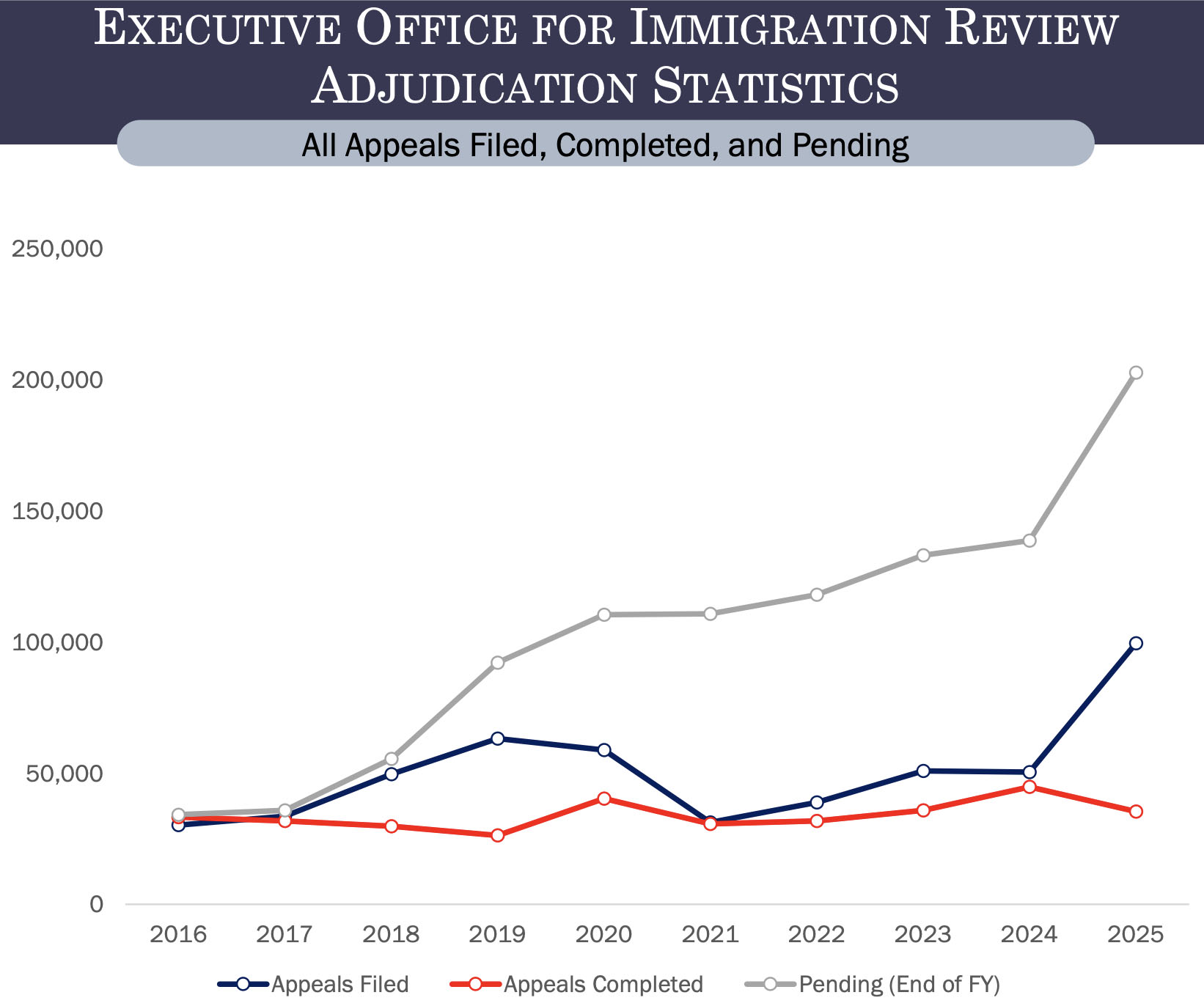 |
CIS suggested additional reforms that EOIR, the DOJ division that is home to the entire immigration court system, could implement to improve the overall integrity of the immigration system.
Appellate Procedures for the Board of Immigration Appeals IFR
In this IFR, DOJ implemented procedural reforms to increase the BIA’s efficiency and reduce its historic backlog by streamlining the appellate body’s procedures and limiting appeals of immigration judge decisions. The current framework invites delay and encourages the routine filing of low-merit appeals, thereby diverting limited adjudicatory resources from cases that warrant meaningful review.
First, CIS supported EOIR’s reform to adopt simultaneous briefing schedules. CIS believes that the costs of extending simultaneous briefing requirements to all cases, rather than only to detained cases, is pointedly outweighed by EOIR’s need to efficiently adjudicate appeals in timely manner and the need to deter additional illegal immigration to the United States.
Second, CIS supported the IFR’s reform that will give the BIA more control over its appellate docket by summarily dismissing all appeals unless a majority of BIA members vote to accept an appeal en banc. This reform will allow the BIA to focus its limited resources on first adjudicating the over 200,000 appeals that are already pending, and then cases that present novel or complex legal issues in the most timely manner reasonable, given the Board’s historic backlog.
Previously, unless subject to the existing, enumerated reasons for dismissal, the BIA reviewed all appeals on the merits. CIS does not believe, however, that this policy is required by law or serves the interests of a functioning immigration system. When the BIA is not burdened by high volumes of low-value appeals, it can devote more time to complex cases that warrant full opinions and produce clear or “bright-line” rules, reducing intra-system variation and the likelihood of inconsistent outcomes across jurisdictions as geopolitical and legal landscapes evolve.
Third, CIS supported the EOIR’s decision to reduce the filing deadline for a non-asylum appeal from 30 days to 10 days. Reducing the deadline to file an appeal from an immigration judge’s decision in non-asylum cases from 30 days to 10 days would promote more efficient and timely administration of the immigration system.
Because the parties have already litigated the relevant issues before the immigration judge, a lengthy post-decision filing period is generally unnecessary to determine whether an appeal will be pursued. A shorter filing deadline would reduce delays in the finality of removal orders, discourage strategic appeals filed primarily to prolong proceedings, and allow the Board to begin adjudicating meritorious appeals more quickly.
Fourth, CIS recommended that EOIR amend its regulations to prohibit immigration judges from abusing their administrative closure authorities beyond what is permitted by law. Current rules have authorized administrative closure in cases that are not consistent with federal law or good governance principles.
EOIR data shows that administrative closure is anything but temporary. Instead, administrative closure has been used as a tool to enable immigration judges and the BIA to allow removable aliens to remain in the United States without any lawful immigration status.
Fifth, CIS recommend that EOIR amend its regulations to impose firmer deadlines for background-check-related requirements. Retaining a “good cause” exception for failures to comply with background check deadlines is sufficient to ensure that individuals who face unusual or unpredictable hardships can proceed with their cases, while also providing strong incentives for aliens in proceedings to comply with these requirements in a timely manner.
The reforms outlined above work in concert to address systemic delays and resource misallocations that have contributed to the current backlog. Implementing simultaneous briefing schedules, limiting appeals to cases accepted for en banc review by BIA, and reducing the filing deadline for non-asylum appeals from 30 days to 10 days will streamline appellate adjudication and ensure that the BIA can focus its limited resources on matters warranting meaningful review. At the adjudicatory level, amending regulations to prohibit immigration judges from exercising administrative closure beyond statutory limits will reinforce the proper bounds of delegated authority and promote timely case resolution, while imposing firmer deadlines for background-check-related requirements will reduce unnecessary continuances and procedural inefficiencies. Collectively, these reforms represent a coherent and necessary response to longstanding structural challenges and will better equip EOIR to fulfill its core mission of delivering fair, timely, and consistent adjudications.