
Summary
- An alien is deportable whose presence or activities in the United States the Secretary of State has reasonable ground to believe would have potentially serious adverse foreign policy consequences for the United States. Secretary of State Marco Rubio made this determination regarding legal resident Mohsen Mahdawi, because of “his leadership and involvement” in anti-Israel demonstrations at Columbia University following the Palestinian terror group Hamas’s massacre of about 1,000 Israeli civilians on October 7, 2023. Mahdawi was then placed into removal proceedings.
- Mahdawi told CBS’s “60 Minutes” that he could “empathize” with Hamas’s massacre. Eight years earlier, in 2015, a Vermont gun shop owner told police that Mahdawi had said that he “used to build modified 9mm submachine guns to kill Jews” in Israel and that “he wished to purchase a sniper rifle and a machine gun”. Another person told police that Mahdawi had said that “I like to kill Jews.”
- A U.S. district court judge in Vermont ordered Mahdawi released from detention after satisfying himself “that the information in the police report does not support a finding of dangerousness” — for, “[i]n a case of the dog that did not bark, the FBI concluded its investigation without taking action” against Mahdawi. However, the acting U.S. attorney had earlier told the judge that “The fact that the investigation was closed should lead to no inference … that there was not derogatory information found about Mr. Mahdawi. In fact, the [FBI] investigation turned up information that was corroborative of the statements recounted in the … police report.”
- On February 11, an immigration judge dismissed the removal proceedings against Mahdawi on the basis that while the determination submitted by the government “looks to be signed by” Secretary of State Rubio, it “is not admissible as it lacked proper authentication”. While “DHS argued the document is self-authenticating”, the immigration judge “disagree[d]”. Cyrus Mehta, one of Mahdawi’s lawyers, commented on “[t]he government’s inability to even file the proper paperwork”.
- The immigration judge’s dismissal was without prejudice — meaning that DHS may refile a new case based on the same charge.
- I would certainly urge the Department of Homeland Security not to abandon its attempt to remove Mohsen Mahdawi — as long as the evidence is persuasive that he has indeed endorsed or espoused terrorism. The Immigration and Nationality Act provides that any alien admitted to the U.S. who “endorses or espouses terrorist activity” is deportable.
- I would suggest that DHS consider seeking Mahdawi’s removal on the basis of the “endorses or espouses” ground of deportation, which stands on much firmer constitutional ground than does the foreign policy ground of deportation.
Introduction
As I have written, following Hamas’s massacre of Israelis on October 7, 2023, then President Biden eloquently proclaimed that “[t]he bloody hands of the terrorist organization Hamas” had unleashed “pure, unadulterated evil”, with “[m]ore than 1,000 civilians slaughtered”, “[p]arents butchered using their bodies to try to protect their children”, “[s]tomach-turning reports of ... babies being killed”. Biden also called Hamas’s attacks against Israeli civilians “a campaign of pure cruelty — not just hate, but pure cruelty — against the Jewish people” and stated that Hamas unleashed “the deadliest day for Jews since the Holocaust ... that [had] reminded us all [of] that expression I learned from my dad early on: ‘Silence is complicity.’”
Well, if silence regarding mass murder is complicity, what should we call the celebration of mass murder? Given it’s safe to assume Hamas would gladly have killed every Jew in Israel had the opportunity presented itself, the celebration of Hamas’s mass murder is not too far removed from the celebration of genocide. And yet, persons in the U.S., both citizen and alien alike, indeed celebrated Hamas’ss mass murder. These celebrations occurred most notably on U.S. college campuses.
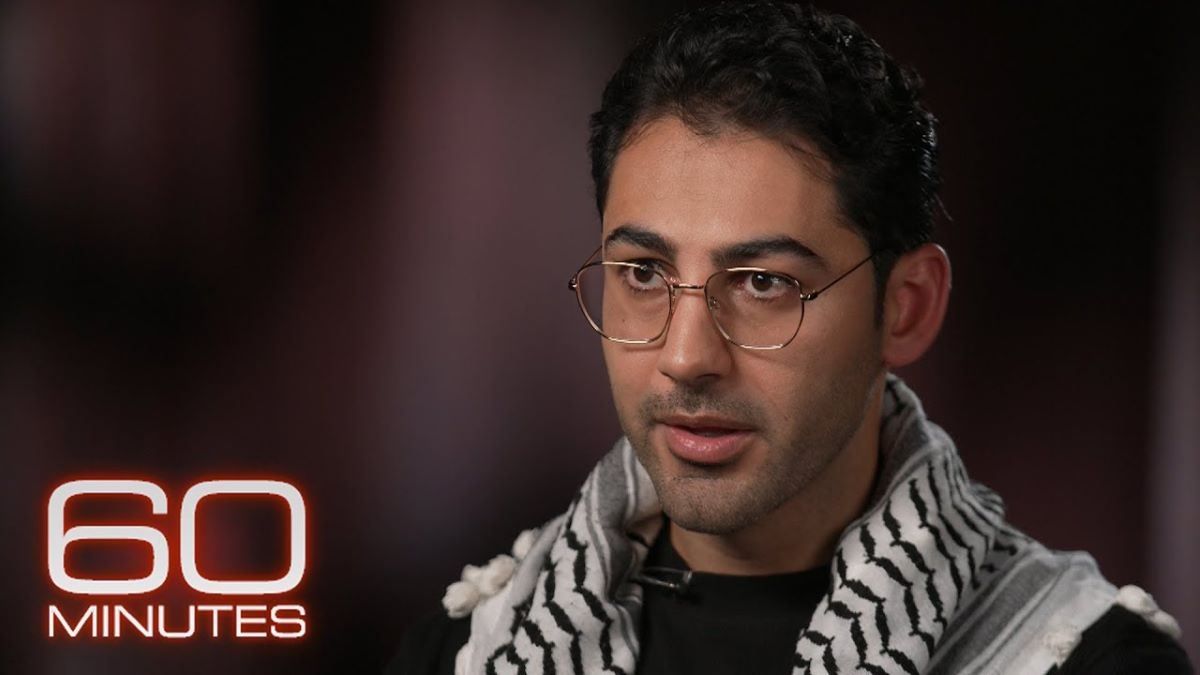
In December 2023, CBS News’s “60 Minutes” aired an episode on the campus protests in which it described fMohsen Mahdawi as having “stepped up to lead a diverse, growing coalition of more than 80 campus groups” protesting at Columbia University.1 In an interview conducted for “60 Minutes” by Bill Whitaker, Mahdawi’s reaction to Hamas’s massacre was that “When somebody’s hurting you, when you see this person [I guess Israeli men, women and children collectively] is being punched in the face, and this feeling, it is, you now feel my pain.”2 When Whitaker interjected that “But this Hamas attack wasn’t a punch in the face, this was a horrible terror attack,” Mahdawi’s response was “I did not say that I justify what Hamas has done, I said I can empathize. To empathize is to understand the root cause and to not look at any event or situation in a vacuum.” Thanks for the distinction, Mohsen.
Removal Proceedings
The Immigration and Nationality Act (INA) provides that “an alien whose presence or activities in the United States the Secretary of State has reasonable ground to believe would have potentially serious adverse foreign policy consequences for the United States is deportable”. This is the so-called “foreign policy” ground of deportability. It includes a proviso that:
An alien [other than an official of a foreign government] shall not be [deportable] … because of the alien’s past, current, or expected beliefs, statements, or associations, if such beliefs, statements, or associations would be lawful within the United States, unless the Secretary of State personally determines that the alien’s admission would compromise a compelling United States foreign policy interest.
On March 15, 2025, Secretary of State Marco Rubio made this determination regarding Mahdawi, signing a memorandum to the Secretary of Homeland Security stating that:
I have determined that the activities and presence of this alien in the United States would have potentially serious adverse foreign policy consequences and would compromise a compelling U.S. foreign policy interest. These determinations are based on information … that Mahdawi, through his leadership and involvement in disruptive protests at Columbia University, has engaged in anti-Semitic conduct through leading pro-Palestinian protests and calling for Israel’s destruction. Mahdawi has been identified at those protests as having engaged in threatening rhetoric and intimidation of pro-Israeli bystanders. The activities and presence of Mahdawi in the United States undermines U.S. policy to combat anti-Semitism around the world and in the United States, in addition to efforts to protect Jewish students from harassment and violence in the United States.
Removal proceedings were commenced, Mahdawi was placed in U.S. Immigration and Customs Enforcement detention, and Mahdawi filed a petition for a writ of habeas corpus in the U.S. District Court for the District of Vermont challenging the removal proceedings and seeking his release from detention. On April 30, 2025, U.S. District Court Judge Gregory Crawford ordered his release during the pendency of the habeas proceeding.
I have written in depth about the foreign policy ground of deportation and the question of its constitutionality, but let me summarize. The ground has been used — and thus tested in court — very rarely. In 1996, a federal district court ruled in Massieu v. Reno that it was unconstitutional for being 1) void for vagueness; 2) in violation of the Due Process Clause of the Fifth Amendment; and 3) an unconstitutional delegation of legislative power to the executive branch. In essence, “Absent a[n alien’s] meaningful opportunity to be heard, the Secretary of State’s unreviewable and concededly ‘unfettered discretion’ ... is ... unconstitutional.” The district court’s decision was overturned on appeal, but the appeals court did not address the constitutional issue.
However, the Supreme Court’s 2018 decision in Trump v. Hawaii seemingly bolstered the case for the foreign policy ground of deportability’s constitutionality. The Court upheld President Trump’s reliance on § 212(f) of the INA to institute a “travel ban” for nationals of certain high-risk countries. Section 212(f) provides that “Whenever the President finds that the entry of any aliens or of any class of aliens into the United States would be detrimental to the interests of the United States, he may … suspend the entry of [such] aliens.” As the Court noted, a president’s power under § 212(f) is extraordinary — it “exudes deference to the President in every clause”. The Court found it “questionable” that § 212(f) requires the president “to explain [his] finding with sufficient detail to enable judicial review” and that “plaintiffs’ request for a searching inquiry into the persuasiveness of the President’s justifications is inconsistent with the broad statutory text and the deference traditionally accorded the President in this sphere”. The Court further stated that “‘any rule of constitutional law that would inhibit the flexibility’ of the President ‘to respond to changing world conditions should be adopted only with the greatest caution,’ and our inquiry into matters of entry and national security is highly constrained”.
However, Trump v. Hawaii dealt with the prevention of the entry of aliens, and, as the Court noted, “foreign nationals seeking admission have no constitutional right to entry”. The Court later explained in 2020 in DHS v. Thuraissigiam that it has “often reiterated th[e] important rule” that “Whatever the procedure authorized by Congress is, it is due process as far as an alien denied entry is concerned.” However, unlike § 212(f)’s bar to entry, the foreign policy ground of deportability applies exclusively to aliens who have already been admitted to the United States. And it has long been the case, as the Supreme Court stated in its 1950 decision in Shaughnessy v. United States ex rel. Mezei, that “aliens who have once passed through our gates, even illegally, may be expelled only after proceedings conforming to traditional standards of fairness encompassed in due process of law”.
Thus, it is not clear whether the Supreme Court would necessarily sign off on the same level of “unfettered” deference in the case of deportation as in the case of an entry bar. There is a real risk that the Supreme Court could adopt the reasoning of the district court in Massieu and declare the foreign policy ground of deportability to be unconstitutional.
Is Mahdawi Dangerous?
What should we make of Mohsen Mahdawi? His lawyers asserted in their Reply to Respondents’ Opposition to Petitioner’s Motion for Release Under Mapp v. Reno (Reply to Respondents’ Opposition) that he “is a beloved member of his communities”, that “[o]ver 130 total declarations in support of Mr. Mahdawi have attested to his peace-loving nature, his deep community ties, and his rootedness in Vermont”, and that “declarations from those who have known him for the past 10 years confirm that ‘his message has been one of peace and tolerance’ and that he ‘bring[s] people together from both sides of the aisle to share a meal and talk’”.
Judge Crawford noted in his Opinion and Order on Motion for Release (Opinion and Order) that:
[O]ver 125 letters of support from professors, neighbors, fellow students, and others who know [Mahdawi] well[ a]ll attest to his mild and peaceful nature, his deep intelligence, and his commitment to principles of non-violence and political activism.
People who have come to know Mr. Mahdawi more recently than 2015 describe him as a peaceful figure who seeks consensus in a highly-charged political environment.
Why the reference to 2015? The Trump administration asserted in its Opposition to Motion for Release Under Mapp v. Reno (Opposition to Motion for Release) that “law enforcement records and [Mahdawi’s] submissions indicate he … has admitted to being involved in and supporting antisemitic acts of violence[ and] has admitted to an interest in and facility with firearms for that purpose”. The Opposition to Motion for Release elaborated that:
In August 2015, Windsor[, Vermont] Police spoke with a local gun shop owner, who reported that earlier that summer [Mahdawi] offered to work in the gun shop without monetary compensation. According to the report, [he] “supposedly told” the gun shop owner “that he had considerable firearm experience and used to build modified 9mm submachine guns to kill Jews while he was in Palistine [sic].”… On another occasion that summer, [he] told the gun shop owner that “he wished to purchase a sniper rifle and a machine gun.”… [without] shar[ing] his purpose in wanting to purchase the weapons. … The gun shop owner referred the police to another member of the community, who also recounted that Petitioner stated in 2015 that “I like to kill Jews.”
Additionally, the administration’s Brief for Respondents-Appellants to the Second Circuit Court of Appeals (appealing Judge Crawford’s order) stated that “[w]hen Mahdawi inquired about the[ sniper rifle and machine gun], he made it known that he ‘used to make guns for ‘Hezballah’”, a State Department designated foreign terrorist organization since 1997. The brief also noted that “The police also spoke to volunteers at the Precision Museum and learned that Mahdawi visited often, took pictures of vintage firearms, expressed interest ‘in purchasing an automatic rifle and a sniper rifle[,]’ and how Mahdawi made it explicit that he ‘like[d] to kill Jews.’”
Mahdawi’s Reply to Respondents’ Opposition stated that “Mr. Mahdawi is unequivocal that he never made the statements misattributed to him in the decade-old reports. In fact, [he] later discussed with [FBI] investigators his concern that the shop owner’s conduct was fueled by animus related to his national origin, and their query with him went no further.” And at Judge Crawford’s hearing, Mahdawi’s counsel Luna Droubi called the police report “a ten-year-old unsubstantiated, anonymous, redacted, unsigned, hearsay written document” and stated that “Calling the issue a national security matter has no basis in reality and is a transparent attempt by the government to deflect, to delay, and to avoid the truth that the document the government attempts to have this court rely upon has no merit.” Further, Mahdawi “felt that he was being targeted, stereotyped as a Palestinian man who identified that he was a Palestinian”.
The FBI had investigated the allegations and had then closed the case. This was all enough for Judge Crawford, who concluded in his Opinion and Order that:
The court is satisfied that the information in the police report does not support a finding of dangerousness. If the FBI had substantiated the information, some action would have resulted. That nothing took place supports Mr. Mahdawi’s description of meeting with [a FBI Special Agent] as satisfying him that the two informants were not truthful.
He … presents no danger to his community or to others. The court has considered the allegations made by the gunsmith in 2015. If true, they are highly damaging to Mr. Mahdawi’s chances of release and of having any future in the United States at all [I would certainly hope so!]. In 2015, the FBI conducted a thorough investigation of the allegations and found no basis to act. Had the statements attributed to Mr. Mahdawi been true, they would have resulted in some official response. In a case of the dog that did not bark, the FBI concluded its investigation without taking action. That decision gives rise to a reasonable inference that the agency charged with the protection of the public from crime found no basis for proceeding against Mr. Mahdawi in any venue. Ten years have passed since that time without any criminal charge except for a referral to a state-run diversion program in 2019 concerning a potential drug offense.
At Judge Crawford’s earlier hearing on the case, he stated that:
All I want to know is very simple, is whether these two gunsmith people made this story up or whether it is true. That’s all I want to know. And it sounds to me as if the FBI concluded that they were not concerned enough about these statements to proceed in some other way. … [T]hey closed their file. … Looks as if on the face of things they weren’t substantiated and there’s some kind of fantasy or malicious conduct by the informants.
I am not sure on what basis Judge Crawford concluded that the U.S. citizens who informed the police of Mahdawi’s alleged comments were fantasizing or acting in a malicious manner. But, in any event, Crawford said to Acting United States Attorney Michael Drescher “I think that is sufficient for me to discount the police report, which is the only thing in front of the Court, as not strong evidence of dangerousness,” noting that “Mr. Mahdawi's attorneys brought forward that the FBI had … looked into it, and I think what you’re telling me is that I can fairly conclude that they found the statements from the gunsmith and from his retired friend to be unfounded. Is that fair?”
Drescher strongly contested Judge Crawford’s conclusion. Drescher in fact responded “No. No.”
Drescher had told Judge Crawford that “Mr. Mahdawi and counsel … argue that the fact that the FBI conveyed to Mr. Mahdawi that they were closing their file should be taken as evidence that there was not more information — or that we discredited the information that was in the police report.” But, in fact, as he said in response to Judge Crawford’s question, “The argument that [Mahdawi’s] counsel made leading to the inference Your Honor just articulated is — it’s inaccurate.”
Drescher said Mahdawi’s argument was inaccurate because:
The fact that the investigation was closed should lead to no inference … that there was not derogatory information found about Mr. Mahdawi. In fact, the investigation turned up information that was corroborative of the statements recounted in the Windsor police report.
There was additional derogatory information about Mr. Mahdawi.
[As to] the shocking parts of the police report, the statements attributed to Mr. Mahdawi … the investigation turned up information that was consistent with Mr. Mahdawi making those statements.
But why then did the FBI close the case file? Drescher explained that it could mean that “there might not be proof of a crime that could be prosecuted beyond a reasonable doubt; or if there was evidence of wrongdoing, that it wasn't in the form of admissible information; or in assessing the relative priorities of the FBI and its resources, the decision was made to move on.”
Further, Drescher explained that “We presented th[e police report] to the Court without referencing the fact that there was a national security investigation that was going on.” He elaborated that:
[T]he source of that information is not subject to disclosure. If the Court wants to get into that information, in open court today I think is not the right forum to do that. I would need to consult with the National Security Division to figure out how to go about doing that. We could perhaps figure out a way to deliver some information to chambers on an ex parte basis. But a national security investigation touches on a lot of sensitive variables that do not get revealed in open court.
Despite Drescher’s clarifications, Judge Crawford concluded at the hearing that “[T]he FBI looked into the matter, spoke with Mr. Mahdawi, and closed its file. … I think that is sufficient for me to discount the police report, which is the only thing in front of the Court, as not strong evidence of dangerousness.”
But Judge Crawford never seems to have given consideration to Drescher’s assurances that the FBI did have derogatory information about Mahdawi, that it had corroborating evidence that Mahdawi made the “shocking” statements that even had Judge Crawford observed that “If true … are highly damaging to Mr. Mahdawi’s chances of release and of having any future in the United States at all.” And it does not appear that Judge Crawford ever took Drescher up on his offer and requested to see the sensitive derogatory information about Mahdawi on an ex parte basis.
The Trump administration appealed Judge Crawford’s order to the Second Circuit, an appeal which is still pending. It stated in its Reply Brief for Respondents-Appellants that, as to Mahdawi’s contention that “the Government ‘does not contest the district court’s findings that [he]’ is not ‘a danger to the public’” — “That is wrong.”
On February 17, lawyers representing Mahdawi sent a letter to the U.S. Court of Appeals for the Second Circuit stating that:
Mohsen Mahdawi submits this … letter to advise the Court that on February 11, 2026, following a hearing, the immigration court held that the Department of Homeland Security had not met its burden of proving removability, and as a result, the immigration court terminated removal proceedings against Mr. Mahdawi without prejudice. The immigration court then issued a written order on February 13 … further explaining its reasoning.
Immigration Judge Nina Froes explained in her written order that:
The Department sought to establish removability by way of a photocopy of a document titled “Memorandum for the Secretary of Homeland Security” that looks to be signed by the U.S. Secretary of State, Marco Rubio, on March 15, 2025. … The Court finds that the Department’s evidence submitted to establish removability … is relevant and probative, [but] is not admissible as it lacked proper authentication. See 8 C.F.R. sec. 287.6, See also [the Board of Immigration Appeals’ (BIA) 2012 decision in Matter of J. R. VELASQUEZ].
The First Circuit has established [that] “[A]uthentication requires nothing more than proof that a document or thing is what it purports to be and, even though the Federal Rules of Evidence spell out various options, the rules also stress that these options are not exclusive and the central condition can be proved in any way that makes sense in the circumstances.” [quoting the First Circuit’s 2004 decision in Yongo v. INS … (citing Fed. R. Evid. 901-902)]. DHS argued the document is self-authenticating. The Court disagrees.
The Court finds that this is an official record and therefore falls within the scope of 8 C.F.R. sec. 287.6 … [which] states “In any proceeding under this chapter, an official record or entry therein, when admissible for any purpose, shall be evidenced by an official publication thereof, or by a copy attested by the official having legal custody of the record or by an authorized deputy.”
This document was not certified or attested. Furthermore, no witness was produced to explain what this document is, how it was obtained and to attest to its validity. See, Yongo [and the BIA’s 1988 decision in Matter of Barcenas].
To the extent that the EARM report I-213 narrative relied upon the same unauthenticated State Department document evidence for purposes of establishing removability, the Court finds that the EARM also fails to establish the INA sec. 237(a)(4)(C)(i) charge by clear and convincing evidence.
The American Civil Liberties Union issued a press release quoting Cyrus Mehta, one of Mahdawi’s lawyers, as saying that “The government’s inability to even file the proper paperwork demonstrates how careless and reckless they are being in their policy of detaining innocent people for their speech.”
Mahdawi and the First Amendment
The ACLU press release quoted Mahdawi:
I am grateful to the court for honoring the rule of law and holding the line against the government's attempts to trample on due process[. ]This decision is an important step towards upholding what fear tried to destroy: the right to speak for peace and justice. Nearly a year ago, I was detained at my citizenship interview not for breaking the law but for speaking against the genocide of Palestinians. In a climate where dissent is increasingly met with intimidation and detention, today’s ruling renews hope that due process still applies and that no agency stands above the Constitution. This is not the end of the story. It is the beginning of a deeper commitment to peace, dignity, and justice; work I will continue, fearlessly and without apology.
I’m sure that Mahdawi, rather than his lawyers, drafted that inspiring statement. Speaking of his lawyers, the ACLU’s press release quoted Mehta:
We’re pleased that the court has terminated this witch hunt of a case[. ]Mohsen is a peaceful man and a valued member of his communities in Vermont and at Columbia University. The government’s pursuit of his deportation has been an affront to the principle of free speech that undergirds our democracy.
Judge Crawford seems to have shared Mahdawi’s and Mehta’s views. He wrote in his Opinion and Order that “even if [Mahdawi] were a firebrand, his conduct is protected by the First Amendment”. Crawford elaborated that:
The court … considers the extraordinary setting of this case and others like it. Legal residents — not charged with crimes or misconduct — are being arrested and threatened with deportation for stating their views on the political issues of the day. Our nation has seen times like this before, especially during the Red Scare and Palmer Raids of 1919-1920 that led to the deportation of hundreds of people suspected of anarchist or communist views. In [the U.S. District Court for the District of Massachusetts’ 1920 decision in] Colyer v. Skeffington3 … Judge Anderson … granted habeas relief to multiple immigrants detained for their political beliefs. His decision was instrumental in bringing an end to the moral panic that gripped the nation and its officials. Similar themes were sounded during the McCarthy period in the 1950s when thousands of non-citizens were targeted for deportation due to their political views. … Again, the fever passed.
The wheel of history has come around again, but as before these times of excess will pass. In the meantime, this case — like Colyer … — is extraordinary in the sense that it calls upon the ancient remedy of habeas to address a persistent modern wrong.
It may come as a shock to Mawdawi and Judge Crawford (though not to Mehta, since he is an immigration attorney) that the INA provides that any alien admitted to the U.S. who “endorses or espouses terrorist activity or persuades others to endorse or espouse terrorist activity or support a terrorist organization” is deportable. In 2005, as chief counsel for the House Judiciary Committee’s Subcommittee on Immigration, Border Security, and Claims, I assisted Committee Chairman F. James Sensenbrenner, Jr. (R-Wis.) and Subcommittee Chairman John Hostettler (R-Ind.) in securing the enactment of this ground of deportability in the “REAL ID Act” (as part of the “Emergency Supplemental Appropriations Act for Defense, the Global War on Terror, and Tsunami Relief, 2005”).
The “endorses or espouses” ground of deportability most likely does not offend the First Amendment. I have written in depth on this subject, but in summary:
- As Supreme Court Justice Brett Kavanaugh concluded in 2012 in his majority opinion in Bluman v. FEC (while serving as a judge on the D.C. Circuit Court of Appeals), “The [Supreme] Court has … indicated that aliens’ First Amendment rights might be less robust than those of citizens in certain discrete areas. See Harisiades v. Shaughnessy ... (First Amendment does not protect aliens from deportation because of membership in the Communist Party).”
- The Supreme Court has made clear that deportation does not equate to punishment.
- While the Supreme Court has circumscribed somewhat Congress’ plenary power over immigration over the years, this has only been the case regarding procedural due process rights, not substantive rights such as freedom of speech.
- The Supreme Court has found campaign finance restrictions regarding aliens to be constitutional even as it has found other restrictions to constitute violations of the First Amendment.
- The Supreme Court has rejected selective prosecution claims and allowed the federal government to single out illegal aliens for deportation based on their support of terrorism.
It appears very likely, though of course not certain, that the Supreme Court would uphold the constitutionality of the removal of an alien on the basis of the “endorses or espouses” ground of deportability (or the identical ground of inadmissibility for an alien present in the U.S. who has not been admitted). The likelihood is highest in the case of an illegal alien and lowest in the case of a permanent resident.
Conclusion
The ACLU’s press release quoted Brett Max Kaufman, senior counsel with the ACLU’s Center for Democracy, as recommending that “The government should take the immigration judge’s hint and drop this absurd case for good.” However, as the release noted, the “ruling was issued without prejudice, which means the government may appeal the decision to the [BIA] or may attempt to refile a new case based on the same charge”.
I did not get the sense that the immigration judge was hinting that the government should drop its removal case against Mohsen Mahdawi, though Judge Crawford did more than hint as to that outcome. It would be more accurate to say that Crawford scrawled his feelings about the case on the biggest billboard in Vermont (that is if Vermont had not banned billboards).
I would certainly urge the Department of Homeland Security not to abandon its attempt to remove Mohsen Mahdawi — as long as the evidence is persuasive that he has indeed endorsed or espoused terrorism. It is one thing for U.S. citizens to celebrate mass murder/genocide. It is quite another for aliens, who are guests of our nation. And if DHS does stay the course, I would suggest that it consider seeking Mahdawi’s removal on the basis of the “endorses or espouses” ground of deportation. It is my belief that it stands on much firmer constitutional ground than does the foreign policy ground.
End Notes
1 Video starting at 6:21.
2 Id. starting at 8:16.
3 265 F. 17 (D. Mass. 2020).