
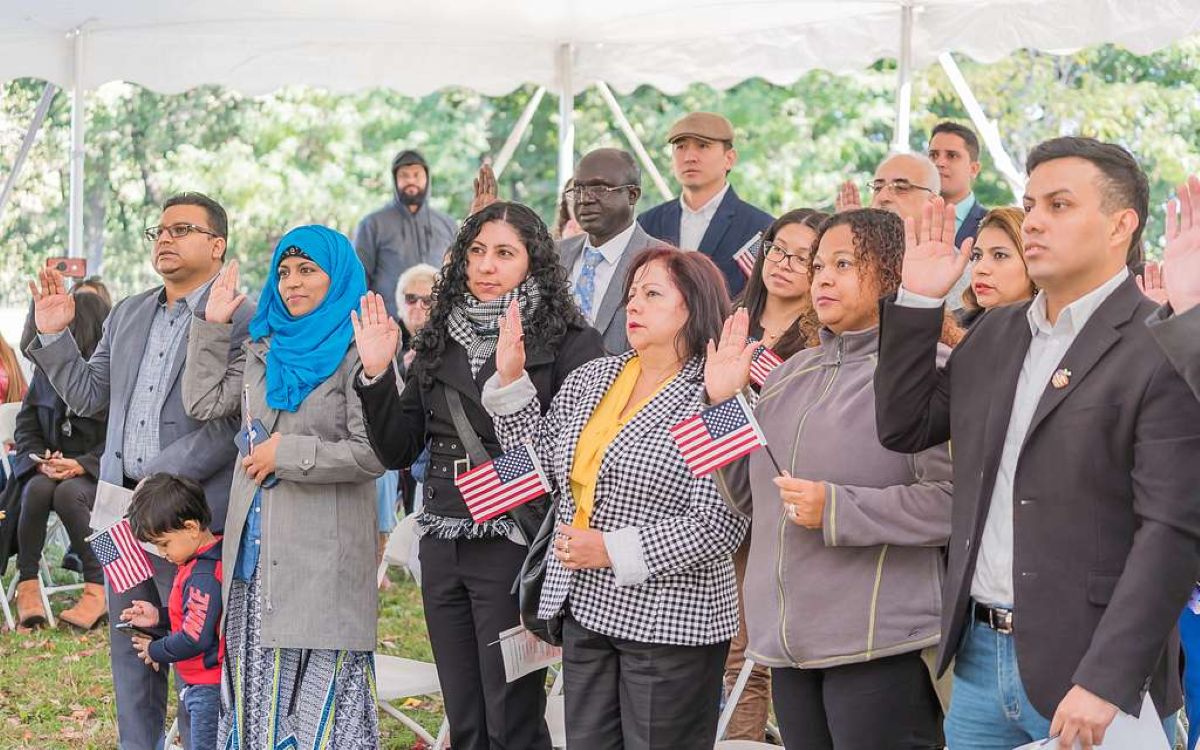
Two very different views of “hyphenated Americanism” in the context of naturalized citizens were articulated in the 20th century, one by then-former President Theodore Roosevelt during World War I and the other in two Supreme Court rulings during and right after World War II. Given the Trump administration’s new focus on denaturalization, these contrasting perspectives could come into play if a case challenging the revocation of citizenship reaches the high court.
Theodore Roosevelt
Ron Elving wrote for National Public Radio a few years back that “President Theodore Roosevelt had a habit of inviting journalists to the White House to share some of his thoughts. In one such chat he coined a phrase that has been part of our political language ever since.” Of course, that phrase is the “bully pulpit”. Elving elaborated:
“Half a dozen of us were with the President in his library,” recalled one participant. “He was sitting at his desk reading to us his forthcoming message. He had just finished reading a paragraph of a distinctly ethical character when he suddenly stopped, swung round in his swivel chair and said ‘I suppose my critics will call that preaching, but I have got such a bully pulpit!’”
On October 12, 1915, the former president delivered a speech to the Knights of Columbus at Carnegie Hall in New York City where he fully utilized his bully pulpit. How did Roosevelt get to Carnegie Hall? Practice, practice, practice! In any event, he famously told his audience that “There is no room in this country for hyphenated Americans.”
Let me set out what Roosevelt said immediately following that admonition. First, he made clear that both naturalized and native-born citizens could have hyphenated loyalties:
When I refer to hyphenated Americans, I do not refer to naturalized citizens. Some of the very best Americans I have ever known were naturalized Americans. … But a hyphenated American is not an American at all. That is just as true of the man who puts “native” before the hyphen as the man who puts German or Irish or English or French before the hyphen.
Then Roosevelt reassured his listeners that “if he is heartily and singly loyal to this Republic, then no matter where he is born, he is just as good an American as anyone else”.
But then Roosevelt warned:
The one absolutely certain way of bringing this nation to ruin, of preventing all possibility of its continuing to be a nation at all, would be to permit it to become a tangle of squabbling nationalities, an intricate knot of German-Americans, Irish-Americans, English-Americans, French-Americans, Scandinavian-Americans or Italian-Americans, each preserving its separate nationality, each at heart feeling more sympathy with Europeans of that nationality, than with the other citizens of the American Republic.
Roosevelt preached to the choir that “Americanism is a matter of the spirit and of the soul. Our allegiance must be purely to the United States.” Thus, “We must unsparingly condemn any man who holds any other allegiance.” He expounded that:
The men who do not become Americans and nothing else are hyphenated Americans; and there ought to be no room for them in this country. The man who calls himself an American citizen and who yet shows by his actions that he is primarily the citizen of a foreign land, plays a thoroughly mischievous part in the life of our body politic. He has no place here; and the sooner he returns to the land to which he feels his real heart-allegiance, the better it will be for every good American. There is no such thing as a hyphenated American who is a good American. The only man who is a good American is the man who is an American and nothing else.
What are the characteristics of a non-hyphenated naturalized citizen?
The foreign-born population of this country must be an Americanized population — no other kind can fight the battles of America either in war or peace. It must talk the language of its native-born fellow citizens, it must possess American citizenship and American ideals. It must stand firm by its oath of allegiance in word and deed and must show that in very fact it has renounced allegiance to every prince, potentate or foreign government.
To Roosevelt, “the three principal essentials” of Americanization were:
[t]he need of a common language, with a minimum amount of illiteracy;
the need of a common civil standard, similar ideals, beliefs and customs symbolized by the oath of allegiance to America; and
the need of a high standard of living, of reasonable equality of opportunity and of social and industrial justice.
He cautioned that “None of these objects can be secured as long as we have immigrant colonies, ghettos, and immigrant sections.”
And in a sharp rebuke to employers relying on immigrants as easily exploitable and cheap labor, Roosevelt made clear that “above all” these objects “cannot be assured so long as we consider the immigrant only as an industrial asset”, that “We cannot afford to continue to use hundreds of thousands of immigrants merely as industrial assets while they remain social outcasts and menaces any more than fifty years ago we could afford to keep the black man merely as an industrial asset and not as a human being.” Immigrants could not be “put at the mercy of the exploiter”.
Roosevelt worried that “[w]e cannot secure … [immigrants’] loyalty unless we make this a country where men shall feel that they have justice”, yet “we have permitted the immigrants, and too often the native-born laborers as well, to suffer injustice”. But, as a corollary, he noted that:
[W]e have failed to impress upon the immigrant and upon the native-born as well that they are expected to do justice as well as to receive justice, that they are expected to be heartily and actively and single-mindedly loyal to the flag no less than to benefit by living under it.
Elites have increasingly belittled Theodore Roosevelt’s pronouncements over the years, as self-doubt (and even revulsion) took hold regarding American values, and multiculturalism and diversity for its own sake replaced unity and assimilation as overarching goals. I would hardly be the first to argue that the results of many decades of ignoring Roosevelt’s wisdom have been disastrous for our country, especially as the foreign-born proportion of the U.S. population reached a record high during the Biden administration (as my colleagues Steven Camarota and Karen Zeigler have documented).
The Supreme Court
How do the U.S. Supreme Court’s views regarding naturalization and naturalized citizens compare with those of Theodore Roosevelt? It is instructive to look at the U.S. government’s attempts to denaturalize Carl Wilhelm Baumgartner, the subject of the Court’s 1944 decision in Baumgartner v. United States, and Paul Knauer, the subject of the Court’s 1946 decision in Knauer v. United States.
The Court issued the first of these two decisions during the Second World War and the second shortly after its conclusion. In both cases, the naturalized citizens at issue were fervent Nazis and devoted followers of Adolf Hitler.
The Court described Baumgartner as follows:
Evidence of statements made by Baumgartner over a period of about seven years beginning in 1933 indicated oft-repeated admiration for the Nazi Government, comparisons between President [Franklin Delano] Roosevelt and Adolf Hitler which led to conclusions that this country would be better off if run as Hitler ran Germany, “that regimentation, as the Nazis, formed it [sic] was superior to the democracy,” and that “the democracy of the United States was a practical farce.” One witness of German extraction testified that Baumgartner told him he was “a traitor to my country” because of the witness’ condemnation of Hitler. Baumgartner made public speeches on at least three occasions … in which he told of the accomplishments of the Nazi Government … .
During 1937 and 1938, Baumgartner conducted a Sunday school class. … The school superintendent … testified that he had received complaints that Baumgartner was preaching Nazism.
There was testimony that Baumgartner justified the German invasions in the late 1930’s, and announced, when Dunkerque fell, that “Today I am rejoicing.”… [T]he diary which Baumgartner kept … reflect[ed] violent anti-semitism, impatience at the lack of pro-German militancy of German-Americans, and approval of Germans who have not “been Americanized, that is, ruined.”
The Court described Knauer as follows:
This record portrays a program of action to further Hitler's cause in this nation — a program of infiltration which conforms to the pattern adopted by the Nazis in country after country. The ties with the German Reich were too intimate, the pattern of conduct too consistent, the overt acts too plain for us to conclude that Knauer was merely exercising his right of free speech either to spread tolerance in this country or to advocate changes here.
We have clear, convincing, and solid evidence that, at all relevant times, he was a thorough-going Nazi bent on sponsoring Hitler’s cause here.
He is a leader — the dominating figure in the cause he sponsored, a leading voice in the councils of the [pro-Nazi] Bund, the spokesman in the program for systematic agitation of Nazi views. His activities portray a shrewd, calculating, and vigilant promotion of an alien cause.
In Baumgartner, the Court ruled that “without ‘clear, unequivocal, and convincing’ proof that [Baumgartner] did not bear or swear true allegiance to the United States at the time of naturalization, he cannot be denaturalized” and that “The evidence in the record before us is not sufficiently compelling to require that we penalize a naturalized citizen for the expression of silly or even sinister-sounding views which native-born citizens utter with impunity.”
In contrast, in Knauer the Court concluded that “there is solid, convincing evidence that Knauer, before the date of his naturalization, at that time, and subsequent, was a thorough-going Nazi and a faithful follower of Adolph [sic] Hitler” and that “when Knauer forswore allegiance to Hitler and the German Reich, he swore falsely”.
I will focus not on the weighty constitutional issues involved in denaturalization (which I plan to explore in a future piece), but rather on the attitude the Supreme Court displayed in both cases regarding “hyphenated Americans” (without ever mentioning the term or Theodore Roosevelt).
Remember that Roosevelt considered one of the three essential principals of Americanization to be “the need of a common civil standard, similar ideals [‘American ideals’], beliefs and customs symbolized by the oath of allegiance to America”, that immigrants’ “allegiance [‘real heart-allegiance’] must be purely to the United States”, that they cannot “feel[] more sympathy with Europeans of th[eir current (or former, if naturalized)] nationality, than with the other citizens of the American Republic”. Remember that Roosevelt proclaimed that naturalized citizens must “stand firm by [their] oath of allegiance in word and deed and must show that in very fact [they] ha[ve] renounced allegiance to every prince, potentate or foreign government”.
The views expressed by the Supreme Court in these two cases regarding Americanism and hyphenated Americans are diametrically opposed to those of Roosevelt’s. I am not talking about the Court’s conclusions as to the parameters that federal law and the U.S. Constitution placed on denaturalization efforts (though, of course, such conclusions might have been influenced by the Court’s views). Under the law at the time, to “revok[e] and set[] aside the order admitting such person to citizenship and canceling the certificate of naturalization” could be done only “on the ground of fraud or on the ground that such order and certificate of naturalization were illegally procured”. I am talking about the sensibilities the Court exhibited regarding the concepts of Americanism and hyphenated Americans.
In Baumgartner, the Court quoted admiringly the “distinguished historian, Gaetano Salvemini, in speaking of his own naturalization” as to “[t]he retention of cultural ties despite [a naturalized citizen’s] change in ‘juridical and political’ status”. Salvemini, as the Court quoted, wrote that a naturalized citizen is “asked to sever [their] connections with the government of [their] former country, not with the people and the civilization of [their] former country”. Fair enough. And the Court stated that “Forswearing past political allegiance without reservation and full assumption of the obligations of American citizenship are not at all inconsistent with cultural feelings imbedded in childhood and youth.” Very anodyne. But the Court twisted Salvemini’s “connection … with the people and the civilization of [their] former country” into something very dark indeed, excusing Baumgartner’s embrace of Hitler and Nazism as merely “offensive exuberance”! The Court wrote:
[D]uring a period when new strength of the land of one’s nativity [Germany] was flamboyantly exploited before its full sinister meaning had been adequately revealed even to some Americans of the oldest lineage, such old cultural loyalty, it is well known, was stimulated into confusion of mind and sometimes to expressions of offensive exuberance.
Do we expect so little of naturalized citizens that we should write-off their embrace of even the most evil programs as mere “exuberance” as long as tied to “cultural loyalty”? In that case, accepting naturalized citizens’ “connection … with the people and the civilization of [their] former country” takes on far more risk for a nation.
The Court also quoted Salvemini as stating that “You are asked to give allegiance to the Constitution of your adopted country — that is, to an ideal of life.” That reflection of Salvemini’s is very much in keeping with Theodore Roosevelt, who emphasized that the immigrant population needs to possess “American ideals”, to have “similar ideals, beliefs and customs”.
But then the Court concluded that:
[S]uch is the contradictoriness of the human mind that the expression of views which may collide with cherished American ideals does not necessarily prove want of devotion to the Nation. It would be foolish to deny that even blatant intolerance toward some of the presuppositions of the democratic faith may not imply rooted disbelief in our system of government.
Views that “collide with cherished American ideals do[] not necessarily prove want of devotion to the Nation”? “[B]latant intolerance toward some of the presuppositions of the democratic faith may not imply rooted disbelief in our system of government”? Such pronouncements by the Court can hardly be squared with Roosevelt’s belief as to immigrants’ needing to possess “American ideals”, and, seemingly, even to Salvemini’s belief that naturalized citizens should give allegiance to the American “ideal of life”.
In Knauer, the Court began by going down the path of Baumgartner’s “offensive exuberance” defense. The Court wrote:
Troubled times and the emotions of the hour may elicit expressions of sympathy for old acquaintances and relatives across the waters.
Human ties are not easily broken. Old social or cultural loyalties may still exist, though basic allegiance is transferred here. The fundamental question is whether the new citizen still takes his orders from, or owes his allegiance to, a foreign chancellory. Far more is required to establish that fact than a showing that social and cultural ties remain.
The Court then noted that, looked at in isolation, “[s]ocial and cultural ties might be complete and adequate explanations” for some of Knauer’s misdeeds. And it stated that: “Even utterances of a political nature which reflected tolerance or approval of the Nazi program … might carry no sinister connotation if ... considered by themselves. For many native-borns in this country did not awaken to the full implications of the Nazi program until war came to us.”
However, the Court in Knauer then pulled back to some extent and ruled Knauer’s denaturalization to be proper since “This is not a case of an underling caught up in the enthusiasm of a movement, driven by ties of blood and old associations to extreme attitudes, and perhaps unaware of the conflict of allegiance implicit in his actions.” So the Court would have found the denaturalization of a naturalized Nazi “underling” improper since he had merely been “caught up in the enthusiasm of a movement, driven by ties of blood and old associations to extreme attitudes”? To me, that distinction is of little comfort.
The Supreme Court has never walked back the sentiments it expressed in Baumgartner and Knauer. I would hope that should the Court again consider a denaturalization case, the justices first take a long hard look at the troubling bromides it tossed off in those cases. And I would hope that the justices would also take the time to read Theodore Roosevelt’s speech of October 12, 1915.