
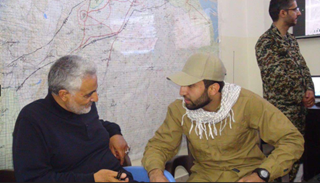
Mohammad Baqer Saad Dawood Al-Saadi (center)
The DOJ recently announced the arrest of Mohammad Baqer Saad Dawood Al-Saadi, an Iraqi national and “senior member of Kata’ib Hizballah [KH], a U.S. designated foreign terrorist organization (FTO)”, who is charged with six counts of terror-related offenses, including an alleged planned attack on a New York Synagogue and other targets. Read down into the complaint in Al-Saadi’s case, and you will see that he purportedly tried to hire a (fortunately fake) Mexican cartel member to do his dirty work — and the implications are not to be ignored.
“Iraqi National Arrested and Charged with Directing Attacks Targeting U.S. Citizens and Interests”
DOJ’s press release is captioned “Iraqi National Arrested and Charged with Providing Material Support to Iranian-Backed Terrorist Organizations and Directing Attacks Targeting U.S. Citizens and Interests”, and it quotes John Eisenberg, the department’s assistant attorney general for national security, who explains:
As alleged, Al-Saadi coordinated a wave of attacks across Europe, including bombings, arson, and assaults targeting American communities and interests. ... The complaint further alleges that Al-Saadi discussed attacking locations in New York, California, and Arizona and presented a serious threat to our national security.
The Counter Terrorism Guide (CTG), a website curated and maintained by the U.S. Office of the Director of National Intelligence (ODNI), describes KH as “an Iran-backed Iraqi Shia militant group” that was formed in 2007 and that currently “threatens US interests in Iraq and Syria”.
That CTG page explains “KH works extensively with Iran’s Islamic Revolutionary Guard Corps–Qods Force (IRGC-QF)”, which in turn is described elsewhere in the CTG as “one of the Iranian regime’s primary organizations responsible for conducting covert lethal activities outside Iran, including asymmetric and terrorist operations”.
The complaint in Al-Saadi’s case alleges that the defendant conspired with others to provide “material support or resources” to both KH and the IRGC-QF, the former beginning around 2017 and the latter in approximately 2019.
Some of that support and those resources, the government contends, were to be directed toward “attempting and conspiring to murder nationals of the United States” (which you may be gratified to learn is a criminal offense under 18 U.S.C. § 2332), and “bombing and conspiring to bomb a place of public use” (a federal crime under 18 U.S.C. § 2332f).
Not all of Al-Saadi’s plots were foiled, assuming DOJ’s charges are correct. The complaint contends that he and others “carried out an attack involving explosives against the Bank of New York Mellon building in Amsterdam” in mid-March, and that he and others “stabbed and seriously injured two individuals, including a U.S. citizen, in London” in late April.
The government further alleged that Al-Saadi and others tried to bomb a branch of the Bank of America in Paris in late March using an improvised explosive device (without success), and “attempted to carry out a terrorist attack against Jewish institutions in the United States” a few days later.
“AL SAADI Attempted to Commit Terrorist Attacks in the United States”
An “Overview” of DOJ’s allegations against Al-Saadi begins on paragraph 11 (on page 4), and if you want to understand how the U.S. government believes terrorist organizations like KF work in conjunction with the Iranian government’s attack dogs in the IRGC-QF to sow mayhem throughout the Middle East and globally, often through cut-outs, paragraph 13 lays it all out for you.
Paragraph 14 includes lots of pictures of Al-Saadi in various submissive poses with former IRGC-QF commander Qasem Soleimani (killed in a U.S. airstrike in January 2020), while subparagraph 15(xvi) includes an alleged posting to his Snapchat account threatening President Trump and making derogatory claims about him (“Oh gambling president oh arrogant one oh clown oh tweet addict star consumer lover of fried chicken and croissants”) and his family.
Paragraph 17, however, includes the most interesting claims from an immigration perspective.
Titled “AL SAADI Attempted to Commit Terrorist Attacks in the United States”, it includes purported excerpts from an April 1 conversation between the defendant and an FBI informant (SOI-1) in which Al Saadi asks SOI-1 if he knew anyone who could carry out attacks on Jewish targets in the United States, and how much they would charge.
During that exchange, SOI-1 allegedly stated that he could “find a Mexican person who is willing to carry out a bombing operation”, prompting Al-Saadi to supposedly ask how that “Mexican person” would carry out a bombing:
When SOI- 1 stated that the contact would likely “throw a hand grenade,” AL-SAADI insisted that he “want[ed] something more powerful.” AL-SAADI inquired if the person(s) carrying out the attack would kill, and SOI-1 responded, “They do everything ... [e]verything has a certain cost.” AL-SAADI responded, “Okay. How do we ... Do you think we should start by having them do a fire?” AL-SAADI further specified when he wanted the attack to happen and how much he was willing to pay, stating: "I want it tomorrow or the day after. Yes, I want it tomorrow or the day after. I want to hit them soon."
Two days later, as per the complaint, SOI-1 introduced the defendant to “UC-1”, an undercover law enforcement officer, and “represented to AL SAADI that UC was Mexican cartel member who had the capability of carrying out terrorist attack in New York and elsewhere in the United States”.
That document continues:
That same day AL SAADI texted UC photograph and map showing the exact location of prominent Jewish synagogue located in New York New York the New York Synagogue AL SAADI directed UC to carry out terrorist attack against the New York Synagogue In doing so AL SAADI texted UC specific information about the New York Synagogue including document in Arabic that described the New York Synagogue's congregation as one supporting the right for Israel to exist.
In addition on or about April 2026 AL SAADI sent UC photographs and maps showing the exact locations of two additional potential U.S. based Jewish institutions to attack namely two prominent Jewish centers in Los Angeles California and Scottsdale Arizona respectively collectively the Jewish Centers AL SAADI also sent UC-1 documents in Arabic describing the Jewish Centers as “staunch supporters of Zionism outside Israel” and a “beacon for solidarity and support to Israel and its Zionist objectives.”
Whether hired guns in the Mexican cartels are fluent in Arabic or care about the political motives of their targets is unclear, but these exchanges suggest two things: (1) purported foreign terrorists believe Mexican cartel members are willing to carry out paid attacks; and (2) they also apparently (albeit purportedly) think cartel sicarios have the reach to do so on both coasts.
Perhaps Al-Saadi and his (alleged) ilk have watched too many movies, but maybe foreign terrorists know the cartels are so much in it for the money that they will attack U.S. targets for pay, suggesting it’s possible cartel torpedoes have been hired to do such work in the past.
“Designating Cartels and Other Organizations as Foreign Terrorist Organizations”
Trump drew fire in January 2025 when he issued Executive Order (EO) 14157, “Designating Cartels and Other Organizations as Foreign Terrorist Organizations and Specially Designated Global Terrorists”.
For example, the Brennan Center for Justice claimed that EO “could harm large numbers of people with no connection to drug trafficking, let alone terrorism”, the Baker Institute for Public Policy argued an earlier iteration of that plan “amounts to death warrants for Mexican criminals”, and the journal Foreign Policy warned it would “harm U.S. businesses” and complicate our relations with countries like Mexico.
Based on my familiarity with both terrorists and cartel members, I too had questions about that plan, but given the terror threat posture the United States and many institutions currently find themselves in and the allegations the government makes in Al-Saadi’s case, I am warming to the idea.
Nothing in the Al-Saadi complaint claims cartels have carried out attacks on behalf of organizations more commonly thought of as “foreign terrorists” in this country, but it certainly suggests they may and — if the contentions in that document are true — at least one high-ranking terrorist leader tried to do just that.
Maybe crime and overdose deaths aren’t the only threat the cartels pose, and if so, a secure border and robust screening policy for all aliens coming to this country are more important than most Americans believe. Respectfully — the stakes are too high to risk any other options.