
During the war in Bosnia of the early 1990s, Kemal Mrndzic, a Bosnian Muslim, served with the Bosnian defense forces. In October 2024, a federal grand jury in Massachusetts convicted Mrndzic on charges that he criminally concealed his service as a supervisor of guards at the notorious Celebici prison camp near Konjic, Bosnia during 1992, in charge of security there, to enter the United States as a refugee and then later to become a lawful permanent resident and naturalized citizen despite his direct engagement in systematic rape, torture, assault, and murder.
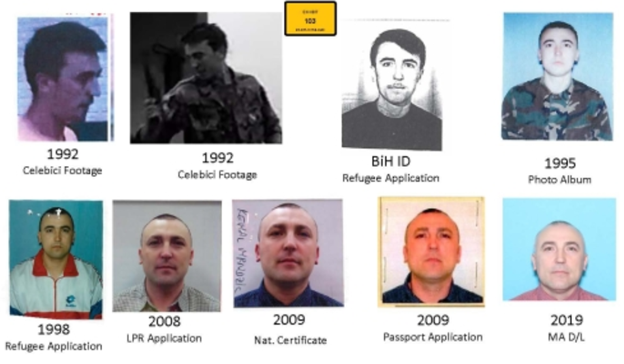
The camp closed in December 1992 and Mrndzic went on to serve as commander of the Musala detention camp, another Serb POW camp detention camp that became widely known for brutal regular abuses of detainees, including murder, an HSI agent complaint stated. After the war ended, Mrndzic went into hiding and, in 1999 entered the United States on an approved refugee application based on an elaborate cover story he provided that went unchecked at the time and again a decade later when he applied for a green card and U.S. citizenship, both granted based on the original fake cover story.
As early as 1996, international investigative agencies were aware of Mrndzic’s crimes and had documented them, including at a major 1998 trial and conviction of four guards, one of whom used Mrndzic’s written testimony for his defense that placed him at the camp as a supervisor. American adjudicators later could have accessed these records at any time but never did.
Had they checked during any of three approval processes, two of them well after post 9/11 security screening reforms were in place, U.S. immigration adjudicators would have learned that dozens of his victims had described Mrndzic as one of the most brutal guards at the camp and had long since attested that he was widely known for his particularly vicious and flagrant public treatment of Serb prisoners.
An ICE press release described Mrndzic as having participated in the “systematic and pervasive brutal torture and deprivation of basic human needs of hundreds of captive victims – some of whom were elderly – at the Celebici prison camp.” He and guards under his command raped women in front of each other, sadistically tortured inmates at random with electric devices and heated knife blades, beat at least eight to death, and withheld food, water, and medicine. One survivor recounted the beating death of a 70-year-old detainee to whom guards had pinned a military badge on his forehead while he was dying.
While in hiding from an international war crimes investigation in Croatia during 1998, Mrndzic applied for U.S. refugee status using a fraudulent cover story that he’d been captured by Serb forces at the war’s start and eventually escaped brutalities of the sort for which he was implicated. In 1998, prior to 9/11-era security vetting reform improvements, the U.S. Citizenship and Immigration Service (USCIS) representative accepted Mrndzic’s detectable frauds at face value.
“At the conclusion of the interview, and upon review of his completed forms…the immigration officer approved Mrndzic’s application as a refugee. In so doing, the immigration officer relied on Mrndzic’s written and oral false statements,” the agent complaint said.
He entered the United States in 1999 to settle in Lynn, Massachusetts with his wife, who was also admitted as a refugee.
In 2008, long after U.S. implementation of more rigorous post-9/11 security vetting reforms, USCIS officers inside the United States approved Mrndzic’s application to become a lawful permanent resident, again accepting elaborate fake stories he’d originally concocted, the agent complaint said.
Again the following year, in April 2009, USCIS approved his application to become a naturalized U.S. citizen based on Mrndzic’s bogus storylines. (This was possible, just one year after receiving permanent residence, because, as the complaint notes, his "lawful permanent residence status was applied retroactively to his original admission date of March 4, 1999.")
In fact, American adjudicators could have easily learned that Mrndzic had always been lying to cover up his crimes at the camps but just checking with the International Criminal Tribunal for the Former Yugoslavia (ICTY). HSI agents had no trouble finding these, plus videos and photographs of Mrndzic at the Celebici camp.
Key among this documentation was a major ICTY investigation of four Celebici camp guards, all later convicted, which surfaced information that Mrndzic had regularly engaged in and ordered the inmate abuses as head of security. The ICTY investigators were aware of the brutality allegations against Mrndzic and that he worked at the camp because they interviewed him that year, filing away the notes. While Mrndzic acknowledged working at the camp, he denied that any abuses took place there.
During his October 1996 interview, Mrndzic himself stated that “the ICTY investigator told him that the Tribunal knows and there is proof that he was involved in the alleged murder” of one prisoner at Celebici.
Furthermore, Mrndzic provided written testimony on behalf of one of the accused guards at the ICTY’s 1998 trial, placing him at the camp in a position of authority, another missed clue that Mrndzic’s fake story given to immigration authorities was at odds with checkable reality.
Having been told ICTY had evidence against him too in 1996, Mrndzic began planning to emigrate to the United States as a refugee.
ICE Homeland Security Investigations agents caught up to Mrndzic in 2022 and showed him the 1996 interview statements they’d had no trouble retrieving. HSI agents also were able to find video recordings taken at Celebici in 1992 in which he appeared in uniform holding a rifle, and military photos too. They’d also found plenty of witness victims willing to provide testimony and brought immigration fraud charges. He was indicted in June 2023.
On October 18, 2024, following a two-week jury trial in Boston, a jury convicted Mrndzic. A judge sentenced him to 65 months in prison.