
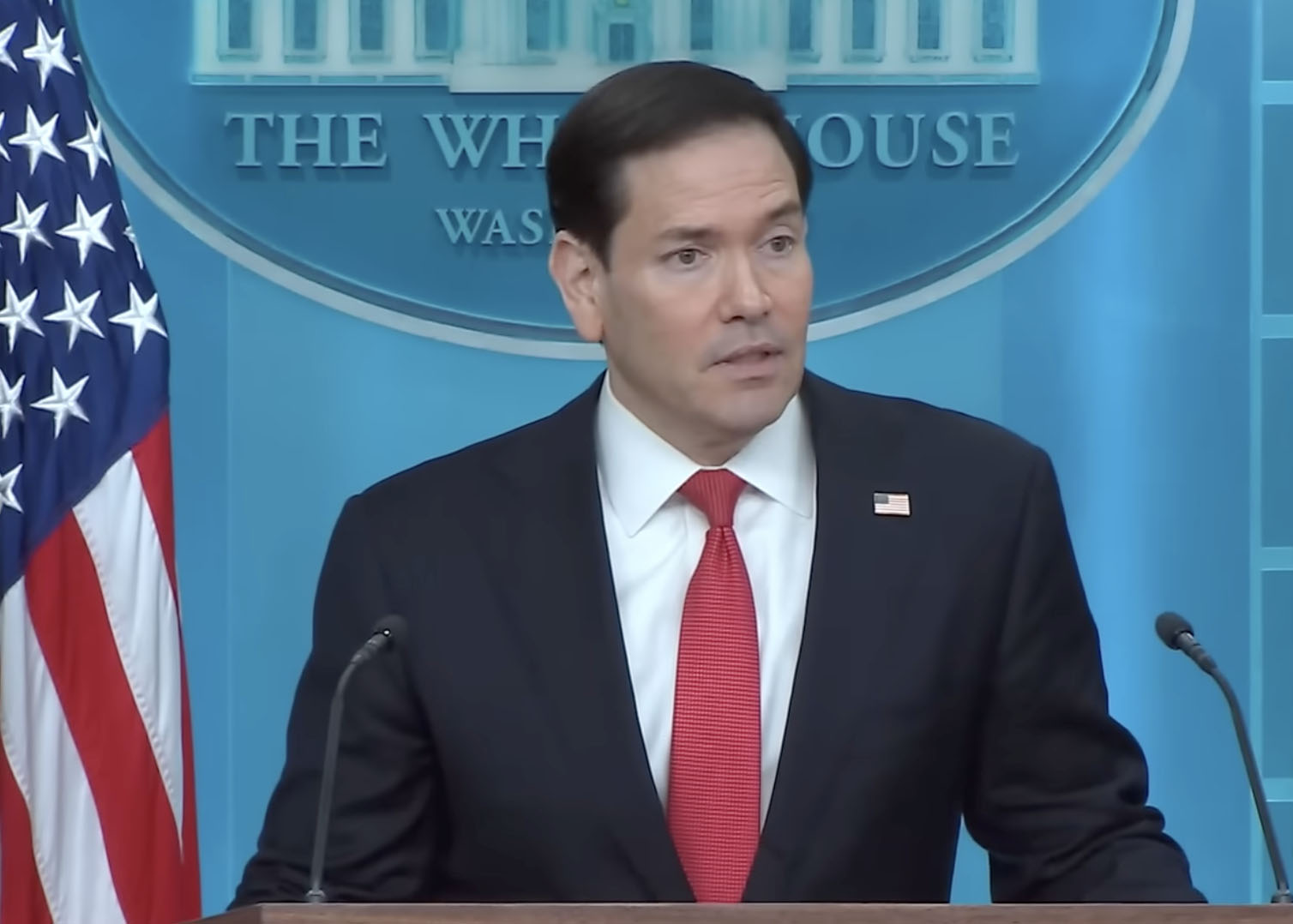
On May 5, Secretary of State Marco Rubio pinch hit for White House Press Secretary Karoline Leavitt, who is on maternity leave. The seasoned pol is a rookie press flack, but though he struggled to identify many reporters in the room, his performance was engaging — and near the end, he offered a description of the promise of America as it nears its 250th birthday of the sort that used to be a staple of political discourse, but has been sorely lacking of late. Here’s why, in my opinion and the opinion of the late Barbara Jordan, it matters to our current struggles over immigration and assimilation.
“My Hope for America Is What It’s Always Been.”
As the press conference was winding down, Rubio had the following exchange with Kelly Wright from CBN News:
WRIGHT: I’ve got to ask you, what is your hope for America at a time such as this?
...
RUBIO: Yeah look, I mean, my hope for America is what it’s always been. I think it’s the hope I hope we all share. We want it to continue to be the place where anyone from anywhere can achieve anything, where you’re not limited by the circumstances of your birth, by the color of your skin, by your ethnicity, but frankly, it’s a place where you are able to overcome challenges and achieve your full potential.
I think that should be the goal of every country in the world, frankly, but I think in the U.S. — we’re not perfect. Our history is not one of perfection, but it’s still better than anybody else’s history. And ours is a story of perpetual improvement. Each generation has left the next generation of Americans freer, more prosperous, safer, and that is our goal as well.
But it is a unique and exceptional country, and as we come upon this 250-year anniversary I think we have a lot to learn and be proud of in our history. It is one of perpetual and continuous improvement where each generation has done its part to bring us closer to fulfilling the vision that the founders of this country had upon its founding.
The Role(s) of the Secretary of State
In addition to serving as secretary of State, President Trump has assigned Rubio multiple other duties in his second term, including acting administrator of the U.S. Agency for International Development (USAID), acting archivist at the National Archives and Records Administration (NARA), and acting national security adviser (NSA).
Henry Kissinger — likely the greatest and most controversial diplomat since Talleyrand — held the NSA job for two years while simultaneously serving as secretary of State under Presidents Nixon and Ford, but no one has ever held so many important U.S. positions at one time, and the burdens Trump has placed on Rubio have become a literal meme.
Not that simply being secretary isn’t a full-time gig, as the individual who holds that post, among other duties: serves as the “President’s principal adviser on U.S. foreign policy”; “conducts negotiations relating to U.S. foreign affairs”; “negotiates, interprets, and terminates treaties and agreements”; “ensures the protection of the U.S. Government to American citizens, property, and interests in foreign countries”; and — critically — “supervises the administration of U.S. immigration laws abroad”.
The secretary also plays a minor but often controversial role in domestic immigration, as well.
Thomas Jefferson — who juggled numerous competing responsibilities his entire life — set the standard when he served as the first U.S. secretary of State under President Washington, and most of his 70 successors have struggled to meet it since he left the position 233 years ago.
The Face of America
Rubio’s task today is likely more onerous than his first predecessor’s was on the cusp of the 19th century, because the current secretary is expected to be the “face of America” abroad in an internet age and under a president who garners plenty of his own attention on the global stage.
That said, he’s uniquely suited for the task. He was “born in Miami to Cuban immigrant parents” and because he “grew up in a Spanish-speaking household”, Rubio is described as “completely bilingual”.
Not that he makes a big deal of it. Much like President Clinton when he spoke at the Brandenburg Gate in July 1994 and offered brief remarks in French (“civil courage”, notably putting the adjective in the wrong place) and German (“Nichts wird uns aufhalten. Alles ist moeglich. Berlin ist frei!"), when Rubio speaks, he doesn’t lean heavily into exaggerated flourishes, like many TV commentators.
That said, he doesn’t shy away from switching into a language nearly 42 million U.S. residents speak at home, though his White House remarks suggest he doesn’t aspire to live in a bilingual nation.
“The Americanization Ideal”
In discussing the importance of assimilation in U.S. immigration, I often rely an op-ed written by Barbara Jordan — civil rights icon, former member of Congress, and at the time chair of the U.S. Commission on Immigration Reform — that appeared in the New York Times on September 11, 1995, headlined “The Americanization Ideal”.
It was written at a time very much like the present, when immigration was a hotly debated topic (though notably during a period when curbing immigration was more of a bipartisan affair) and it encapsulated what Jordan thought “reform” of our immigration system should look like.
As she explained:
Immigration imposes mutual obligations. Those who choose to come here must embrace the common core of American civic culture. We must assist them in learning our common language: American English. We must renew civic education in the teaching of American history for all Americans. We must vigorously enforce the laws against hate crimes and discrimination. We must remind ourselves, as we illustrate for newcomers, what makes us America.
The first two “obligations”, while self-evident, have fallen into disrepute of late, the former for reasons I will discuss and the latter in apparent pushback against the imputed ill-intentions of Americans who want to engage in commerce and discourse with their neighbors in a common tongue.
Speaking of Jefferson, he considered Spanish to be the second most important language for Americans to learn after French (the lingua franca of his time), because “the antient [sic] part of American history is written chiefly in Spanish”. Little could he imagine that much of “the future part of American history” would be, too.
That said, immigrants who aren’t fluent in “American English” will find themselves shut out of many if not most civic and commercial opportunities and thus threaten to fracture what has always been a fragile body politic, so kudos to those who volunteer to teach the language to newcomers and shame to anyone who opposes lingual integration.
“We Must Remind Ourselves What Makes Us America”
That said, the most important and difficult-to-comprehend sentences in that paragraph come at the end, as Jordan addresses the burdens assimilation imposes on U.S. natives and long-time immigrants.
Three decades ago, when Jordan wrote them, most likely questioned how “civic education” played any role in integrating newcomers. After all, aliens bear the burden of passing a civics test to become citizens, so the burden is theirs alone.
Thirty-plus years hence, Jordan’s words are largely forgotten, but the salience of her points is more evident. Many on the right argue — and not without basis — that from kindergarten to post-doctoral education, young Americans are taught nothing but the mistakes of our past, and none of our accomplishments and achievements.
But if you want to pull back and understand why Europe has been wrestling with a seemingly never-ending migrant crisis, look no further.
Last June, I was invited to debate at the Oxford Union at the eponymous university in the eponymous village in England, self-described as “the most prestigious debating society in the world”.
Oxford University is ranked fourth by U.S. News and World Report among global universities, and those who study there have truly won the Western world’s “life lottery”, and yet all whom I debated against and many in the audience had nothing but distain bordering on hatred and contempt for the West.
One of my opponents suggested that the UK and other Western countries offer “reparations visas” to make amends for the harm they had done around the world, which honestly sounded like the sort of thing President Trump would “Truth” out in mockery.
And although I saw plenty of Palestinian banners, I never once glimpsed the Union Jack in the two days I spent in Oxford, and I can assure you — as I trust Jordan would as well — that a Britain governed by “future leaders” who hate their fellows and rue their past will fail, both in assimilation and otherwise.
Which brings me back to Secretary Rubio’s impromptu speech, in which he hit every mark Jordan set out for him.
“We must remind ourselves, as we illustrate for newcomers, what makes us America”?
“My hope for America is what it’s always been”, and “we want it to continue to be the place where anyone from anywhere can achieve anything” and “you’re not limited by the circumstances of your birth”, but “you are able to overcome challenges and achieve your full potential”.
And America “is a unique and exceptional country, and we have a lot to learn and be proud of in our history”.
“We must vigorously enforce the laws against hate crimes and discrimination”?
“Our history is not one of perfection”, but “ours is a story of perpetual improvement”.
Trust me, I grew up in the 70s, and if you want to know how much improvement has been made in the interim, just google “George Wallace” and look at his remarkable career arc.
“We must remind ourselves, as we illustrate for newcomers, what makes us America”?
“Each generation has left the next generation of Americans freer, more prosperous, safer, and that is our goal as well.”
Chemo for the Body Politic
As Jordan makes clear, public and common distain for America impedes assimilation, and yet contempt for our history, past and present, has grown like a cancer in many of our major institutions (academia, media, courts of law, and politics itself, just to name a few).
Rubio’s brief and impromptu remarks are, I hope, the start of chemotherapy to shrink this tumor, if for no other reason than, as Jordan suggested, the “Americanization ideal” cum assimilation is impossible until it is.
Respectfully, it should come as little surprise that it has taken the child of immigrants to administer it, because a fresh perspective often offers a truer vision.
No historian or political scientist better set the stage for telling the story of America than Alexis de Tocqueville, a Frenchman who compiled the materials for his two-volume Democracy in America during a 10-month quasi-exile in this country in the early 1830s, ostensibly to study prison reform.
The result was not all plaudits (he appropriately despised slavery and had unkind things to say about U.S. roads), but he came away with the following sentiment: “America is a land of wonders, in which everything is in constant motion and every change seems an improvement. The idea of novelty is there indissolubly connected with the idea of amelioration.”
Jordan described America as “a kaleidoscope, where every turn of history refracts new light on the old promise”, and both de Tocqueville and now Rubio have offered their own opinions as they have looked with fresh eyes through the lens.
It’s good that our chief diplomat, who “supervises the administration of U.S. immigration laws abroad”, not only understands what is best about America but is willing, unprepared, to express it in this cynical age. Assimilation has long been a challenge here for both alien and native, but if more public figures follow Marco Rubio’s elegant and heartfelt lead, the process will be much easier.